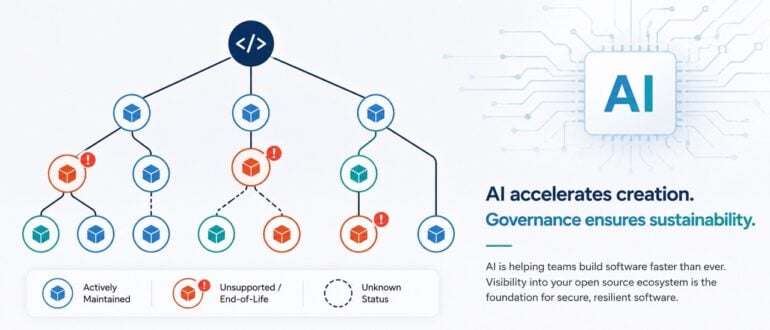
With AI, teams across organizations are now building internal applications faster than ever, often pulling in open source libraries and frameworks without much thought about long-term support, lifecycle management, or security ownership. An unintended consequence of this is that unsupported open source software (OSS) is quietly spreading across environments faster than security and engineering teams can keep track of it.
Most organizations already struggled with open source visibility before AI-assisted development became mainstream. Now, many are also accumulating technical debt at a much faster rate, creating future maintenance, security, and migration obligations every time new dependencies are introduced.
The question is no longer simply how fast organizations can build software with AI. It’s whether they can securely govern and sustainably support the software ecosystems they are creating.
Unsupported OSS is Becoming a Major Blind Spot
Many organizations already have unsupported frameworks and abandoned dependencies inside critical applications; most just do not realize it yet. As AI expands software development beyond traditional engineering teams, it’s becoming easier than ever to introduce open source dependencies without understanding whether projects are actively maintained, security patches still exist, or frameworks are approaching end-of-life.
The result is fragmented software stacks and growing visibility gaps across enterprise environments. It is also accelerating the accumulation of technical debt, creating future maintenance, support, and migration obligations every time new dependencies are introduced. Much of that debt remains hidden until a security issue, compliance requirement, or modernization effort forces it into the open.
While AI is dramatically increasing the speed and breadth of vulnerability discovery across open source ecosystems, the harder challenge is validating findings. This includes understanding exposure, prioritizing remediation, and fixing issues safely, all work that still depends heavily on maintainers and security teams already stretched thin.
AI is Breaking the Traditional Security Feedback Loop
For years, open source security operated on an imperfect but manageable equilibrium. Vulnerabilities were discovered relatively slowly, maintainers had time to validate reports, and engineering teams could prioritize remediation in cycles that were difficult but sustainable. AI is disrupting that balance.
The imbalance between vulnerability discovery and remediation is already becoming visible across the open source ecosystem. Recent reporting around Spring projects illustrates how quickly vulnerability discovery is accelerating. After 17 CVEs were disclosed across all of 2025, between this last March-April alone, 30 CVEs were reported.
Organizations are now trying to manage exponentially larger software ecosystems using governance and remediation models designed for a much slower era of software development. That imbalance is becoming increasingly difficult for maintainers, security teams, and enterprises to absorb.
Governance Needs to Catch Up to the Speed of AI
Open source is not going away. AI will only make it more foundational to how software gets built. But enterprises can no longer treat open source governance as an informal process handled only during vulnerability remediation cycles.
As AI accelerates software creation, organizations need better insight into the open source software running across their environments, including which components are unsupported, approaching end-of-life, or no longer actively maintained. It’s no longer enough to know which components have vulnerabilities. Organizations also need to know whether the software they depend on can still be supported and secured over the long term.
Enterprise and security leaders should focus on a few practical priorities:
Identifying unsupported and end-of-life dependencies before they become operational risks
Understanding which OSS components are business-critical and actively maintained
Reducing Reliance on Reactive “Scan and Patch” Remediation Cycles Alone
Building longer-term support and lifecycle planning into how open source software is adopted and maintained
Open source remains foundational to modern software development. But as AI accelerates software creation and vulnerability discovery simultaneously, unsupported OSS is becoming harder for enterprises to govern, support, and secure at scale.
Organizations that navigate this shift most successfully will not simply be the ones building software fastest. They will be the ones capable of maintaining visibility into the open source software they depend on and treating OSS governance as a core operational discipline, not an afterthought once vulnerabilities appear.
from DevOps.com https://ift.tt/uTSrIAB
Comments
Post a Comment