
Latest OpenTofu Release Simplifies Configuration Updates

The latest update to the OpenTofu infrastructure-as-code (IaC) tool is making it simpler to update and refactor configurations without having to rework the entire codebase.

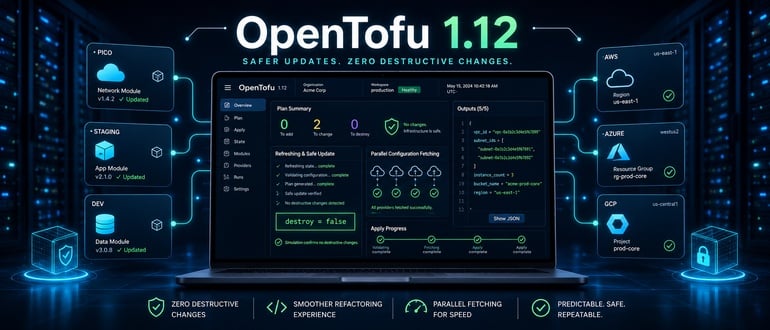
Version 1.12.0 of OpenTofu has added a destroy = false lifecycle option that enables DevOps engineers to drop an object from state without issuing a destroy application programming interface (API) call.

Previously, any time a resource was updated or added an API call would try to destroy the actual infrastructure behind it. While DevOps teams could work around that issue by carefully maintaining state, the chances that something could go awry were fairly high.

Now OpenTofu 1.12.0 allows DevOps teams to tie prevent_destroy to an input variable within the same module. Once set to default, the API call to destroy the IT infrastructure environment is overwritten. That per-stack variable configuration means DevOps teams can define the safety behavior once per environment and have it stay consistent across every run.

Version 1.12.0 of OpenTofu also makes it simpler to fetch configurations in parallel to reduce the amount of time required multiple times a day to perform that task.

Finally, a -json-into=FILENAME has been added that writes a structured JSON stream to a separate file, while the terminal continues to show standard human-friendly output. That capability promises to make it simpler to build a progress tracker or a notification system without giving up the terminal experience or having to run the command twice.

Jonah Kowall, senior vice president of product for Spacelift, a provider of an IaC orchestration platform that contributes code to the OpenTofu project, said OpenTofu 1.12.0, in general, now makes upgrading or adding resources to configurations a much more routine type of task.

Currently being advanced under the auspices of the Cloud Native Computing Foundation (CNCF), OpenTofu has been gaining traction as an alternative to the open source Terraform project managed by the HashiCorp arm of IBM. In fact, Spacelift reports that more than 50% of all runs on its platform are driven by OpenTofu.

Going forward, the maintainers of the project are also looking at revamping the underlying engine the project relies on to make the overall platform more efficient, said Kowall. The current engines are based on a fork of the Terraform project that was initially used to create OpenTofu when HashiCorp changed its licensing terms.

As OpenTofu continues to evolve, the maintainers of the project are betting that as they address longstanding Terraform issues, the number of organizations willing to switch IaC tools will continue to increase, said Kowall. As has been shown in the past, multiple teams and organizations contributing to an open source project creates a flywheel of innovation that no single IT vendor can match, he added.

The only issue many organizations making that decision will need to contend with, of course, is finding a way to manage IT environments made up of a mix of OpenTofu and Terraform code that might, in one form or another, be around for many years to come.


from DevOps.com https://ift.tt/xO0VrEp

Comments

Popular posts from this blog

Cursor’s New SDK Turns AI Coding Agents Into Deployable Infrastructure

For most of its life, Cursor has been an IDE. A very good one. But with the public beta of the Cursor SDK, the company is making a different kind of move — one that should get the attention of DevOps teams. The Cursor SDK is a TypeScript library that gives engineers programmatic access to the same runtime, models, and agent harness that power Cursor’s desktop app, CLI, and web interface. In short, the agents that used to live inside an editor can now be invoked from anywhere in your stack. That’s a meaningful shift in how AI coding tools fit into software delivery pipelines. From the Editor to the Pipeline If you’ve used Cursor before, the workflow is familiar — you interact with an agent in real time, asking it to write functions, fix bugs, or review code. The SDK breaks that dependency on interactive use. Now you can call those same agents programmatically, from a CI/CD trigger, a backend service, or embedded inside another tool. Getting started is a single inst...

Mistral Moves Coding Agents to the Cloud — and Gets Out of Your Way

For the past year or so, AI coding agents have been tethered to your local machine. You kick off a task, watch the terminal, and babysit every step. It works — but it’s not exactly hands-free. Mistral just changed that. On April 29, the Paris-based AI company announced remote coding agents for its Vibe platform, powered by a new model called Mistral Medium 3.5. The idea is simple: Instead of running coding sessions on your laptop, they now run in the cloud — asynchronously, in parallel, and without you watching over them. What’s Actually New Coding sessions can now work through long tasks while you’re away. Many can run in parallel, and you no longer become the bottleneck at every step the agent takes. That’s the core pitch. You start a task from the Mistral Vibe CLI or directly from Le Chat — Mistral’s AI assistant — and the agent handles the rest. When it’s done, it opens a pull request on GitHub and notifies you, so you review the result inste...

GitHub Resets Copilot Pricing as AI Compute Costs Surge

The development community saw this one coming: GitHub will transition its Copilot service to a usage-based billing model on June 1, replacing its existing system of fixed subscriptions supplemented by premium request limits. As reported last week, GitHub suspended new sign-ups for several of its Copilot subscription tiers as it faced a surge in demand from agentic coding workflows. To address that, under GitHub’s new pricing model, customers across individual, business, and enterprise tiers will receive a monthly allocation of AI credits, which are consumed based on token usage. This includes input, output, and cached data processed by underlying models. Once those credits are exhausted, users can purchase additional capacity at published rates. The change leaves base subscription prices intact. Individual plans remain priced at $10 per month for Pro and $39 for Pro+, while business and enterprise tiers continue at $19 and $39 per user per month, respectively. Each plan’s monthly ...