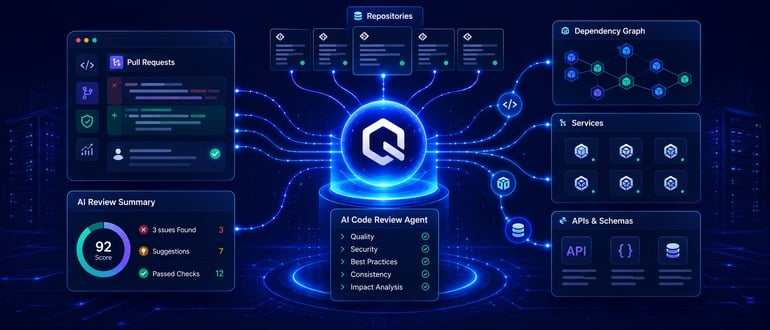

Qodo this week extended its platform for managing code quality and governance to enable an artificial intelligence (AI) agent to review code spanning multiple repositories.
Additionally, version 2.8 of the Qodo platform adds a custom rules miner that discovers coding patterns from existing codebase behavior and pull request (PR) history that are then used to create structured, enforceable rules.
Finally, Qodo has added an ability to discover AI skills that contain code review instructions, coding standards, and engineering best practices across multiple repositories. The platform surfaces those skills in a portal that enables DevOps teams to centrally manage and assess their impact on software engineering workflows.
Qodo CEO Itamar Friedman said these capabilities extend an agentic AI platform for governing code that is based on graph technology that tracks the relationships that exist between code.
Whenever a pull request (PR) modifies a shared dependency, the agent reads the repositories affected to surface impact findings before the PR is merged. As a result, issues such as function signature violations, contract breaks between application programming interfaces (APIs), changes to schemas and infrastructure drift all become visible.
In the age of AI coding, the bottleneck that stymies DevOps teams has moved from writing code to reviewing it, said Friedman. As the volume of code being generated continues to increase, human developers are now able to keep pace with the rate of change, he added. The graph technology that Qodo developed specifically for code makes it possible for both AI agents and human developers to focus their time on where proposed changes could create issues that should be resolved before code is allowed to be checked into a codebase, noted Friedman.
Available in beta, the code review capability spanning multiple repositories that Qodo has added makes it possible to readily see how a code change might adversely impact a microservice without requiring software engineers to manually review every line of code, said Friedman.
The ultimate goal is to enable DevOps teams to start identifying the tasks and bottlenecks today that are consuming the most time to better identify when and where to apply AI agents in a way that has the most substantial impact on moving higher quality code into production environments as fast as possible, said Friedman.
At this juncture, it’s apparent that humans will not be able to review every line of code created using an AI tool. The only way to identify issues will be to rely more on AI agents to review code created by other AI agents. The challenge is making sure that the AI agent reviewing the code is not based on the same AI model used to create the code in the first place. Otherwise, DevOps teams are essentially relying on an AI agent to grade its own homework.
Eventually, software engineering will evolve into a system of AI agents, otherwise known as an AI factory, that will need to be orchestrated and supervised. The challenge now is laying a solid foundation upon which that AI factory will ultimately be built.
from DevOps.com https://ift.tt/2wozkr3
Comments
Post a Comment