

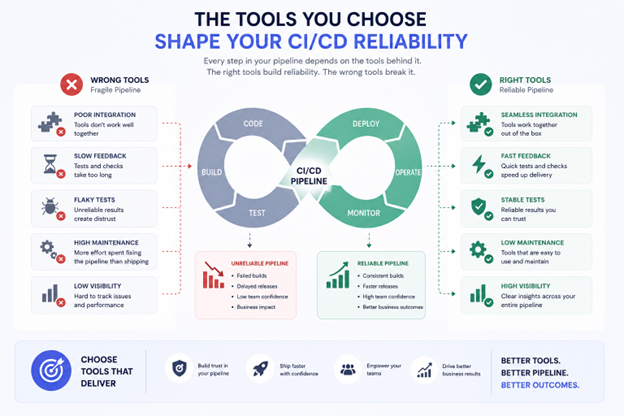
Most conversations about CI/CD reliability start in the wrong place. Teams debug flaky pipelines, investigate intermittent failures, tune alerting thresholds and optimize build times. All of that work is legitimate. However, the decisions that most directly determine whether a CI/CD pipeline is reliable or not were made months or years earlier, during tool selection. By the time teams are debugging pipeline reliability, they are usually dealing with the downstream consequences of upstream decisions that seemed reasonable at the time.
The software development tools a team chooses shape their CI/CD pipeline in ways that are not always visible during evaluation. Understanding those connections is the most practical starting point for teams that want reliable pipelines rather than better pipeline firefighting.
The Integration Surface Problem
Every tool in a software development stack creates an integration surface. Integration surface is the set of connections a tool has with other tools in the pipeline — how it passes data, triggers actions, reports results and handles failures.
A tool evaluated in isolation always looks better than a tool evaluated in the context of everything it needs to connect to. This is the fundamental evaluation mistake. A testing tool with excellent standalone performance may produce output in a format that nothing else in the pipeline reads natively. A deployment tool with strong features may require custom scripting to connect to the monitoring platform that catches post-deployment failures. Each custom connection is a fragility point. Each fragility point is a potential pipeline failure that has nothing to do with the code being deployed.
Teams with reliable CI/CD pipelines tend to have one characteristic in common: They evaluate the integration surface as seriously as they evaluate features. The tools they chose were not necessarily the most capable in each category. They were the tools that composed cleanly with everything else.
How Testing Tool Choices Propagate Through the Pipeline
Of all the software development tools in a typical stack, testing tools have the most direct and underappreciated effect on CI/CD reliability.
The reason is not test execution speed, though that matters. It is how testing tools handle the dependency problem. Every automated test that touches an external service, a database or a downstream API has to deal with the question of how to represent that dependency during test execution. The answer to that question — whether it involves live dependencies, containerized replicas, hand-written mocks or recorded interactions — determines how reliably the test suite behaves across different pipeline environments.
Testing tools that leave the dependency question entirely to developers produce inconsistent results across environments. The same test passes locally, fails in CI and passes in staging for reasons that have nothing to do with the code. Each unexplained inconsistency erodes trust in the pipeline. Teams that stop trusting their pipeline results add manual verification steps. Manual verification steps slow down delivery. Slow delivery creates pressure to skip testing. The reliability problem compounds from a testing tool decision made at the start of the project.
Testing tools that have a principled approach to dependency handling — one that works consistently across local, CI and staging environments — produce pipelines that engineers trust. Trusted pipelines get used properly. Properly used pipelines catch regressions before production.
This connection between testing tool design and pipeline reliability is consistently underweighted during tool evaluation because it is not visible in demos or documentation. It only surfaces under real conditions, after adoption.
The Observability Gap
A second category of software development tools with direct pipeline reliability consequences is observability tooling. This seems obvious, but the way observability tools are typically adopted creates a specific reliability gap.
Most teams adopt observability tools for production monitoring. They instrument their services, set up dashboards, configure alerts and build runbooks. The observability stack covers what happens after deployment. What it typically does not cover is the pipeline itself.
When a CI/CD pipeline fails, the diagnostic information available determines how quickly the failure is understood and resolved. Teams with observability tooling that covers pipeline execution — test failure patterns over time, build time trends, environment-specific failure rates, deployment success rates by service — resolve pipeline incidents significantly faster than teams whose observability stops at the production boundary.
The tool selection decision that creates this gap is not choosing the wrong observability tool. It is choosing observability tools without asking whether they cover the pipeline as a first-class environment. Most monitoring platforms do. Most teams do not configure them that way.
Version and Dependency Management Compounds Over Time
Software development tools that handle versioning and dependency management are among the least exciting choices teams make and among the most consequential for long-term pipeline reliability.
The reliability problem with version and dependency management tools is not immediate; it accumulates. A tool that does not enforce strict version pinning produces pipelines that work consistently for months and then start failing intermittently as upstream dependencies shift. A tool that does not surface transitive dependency conflicts clearly produces pipelines that fail in ways that are difficult to attribute to a specific change.
Neither of these failure modes is visible during evaluation. They surface after 6–18 months of production use, at a point where switching tools is expensive and the original selection decision is forgotten. By then, the reliability problem looks like a maintenance problem or a pipeline hygiene problem rather than a tool selection consequence.
Teams that maintain reliable pipelines over multi-year timescales tend to have been deliberate about version management tooling from the start, not because they anticipated specific failure modes, but because they asked harder questions during evaluation: How does this tool behave when upstream packages change without notice? How does it handle conflicting transitive dependencies? What does failure look like when dependency resolution fails?
The Evaluation Framework Most Teams Skip
The practical implication of all of this is that tool evaluation for CI/CD reliability requires a different framework than tool evaluation for features.
Feature evaluation asks: What can this tool do? Reliability evaluation asks: How does this tool fail, and what does that failure do to the pipeline around it?
These are uncomfortable questions to ask vendors and open-source maintainers. They are also the most informative questions available. A tool whose failure modes are well-documented, bounded and recoverable is a reliably behaved tool even when it fails. A tool whose failure modes are opaque, unbounded or cascading is a reliability risk regardless of its feature set.
Before applying any reliability-focused evaluation framework, it helps to have a clear picture of what the current landscape of software development tools actually looks like across the development life cycle — from version control and CI/CD to testing and observability.
The software development tools that produce reliable CI/CD pipelines are not the tools with the most impressive feature lists. They are the tools whose failure modes are understood before adoption. That understanding only comes from asking specifically about it during evaluation — not from reading documentation, not from watching demos and not from running a two-week proof of concept under ideal conditions.
Reliability is a Tool Selection Consequence
CI/CD reliability is not primarily a configuration problem or a maintenance problem. It is a tool selection consequence that plays out over the lifetime of the pipeline.
The teams that recognize this evaluate differently. They spend more time on the integration surface than on feature comparison. They ask about failure modes before they ask about integrations. They treat dependency management tooling with the same seriousness they treat deployment tooling. They build observability coverage of the pipeline itself rather than stopping at the production boundary.
None of these practices requires more budget or more engineering time. They require asking different questions at evaluation time — questions that shift the selection criteria from what tools can do in isolation to how tools behave as part of a system.
This shift is the most direct path to a CI/CD pipeline that engineers trust enough to use properly, and a pipeline that engineers trust is, by definition, a reliable one.
Conclusion
The next time a pipeline fails, and the postmortem points to a tool integration gap, a flaky test environment or a dependency conflict that appeared without warning, it is worth asking when the affected tool was last evaluated against reliability criteria rather than feature criteria. The answer is almost always never. Changing that answer — making reliability a first-class evaluation criterion alongside capability — is the single most effective investment a team can make in the long-term health of their CI/CD pipeline. The tools are already out there. The question is whether the process for choosing them is asking the right things.
from DevOps.com https://ift.tt/xkcI8iD
Comments
Post a Comment