Adoption and Fragmentation of AI in CI/CD—and Operational Readiness

In today’s enterprise software delivery environment, AI has moved from a distant possibility to an active area of experimentation across the CI/CD pipeline. The conversation around AI in software delivery often runs ahead of the underlying reality, and most organizations are still working through what it takes to operationalize AI inside delivery architectures that were built long before AI was a practical consideration.

Techstrong polled its community of DevOps, platform engineering and software delivery professionals to understand where AI adoption in CI/CD really stands, where it is being applied today, and what is standing in the way of broader operationalization. Our findings reveal that active interest is running ahead of operational readiness, with most organizations either experimenting in isolated areas or beginning to expand AI use in selected parts of the pipeline, while fragmented toolchains, governance concerns and integration complexity remain the primary barriers to scale.

Techstrong brings you this PulseMeter report sponsored by CloudBees, supported by our independent research data. Learn more by downloading the full report.
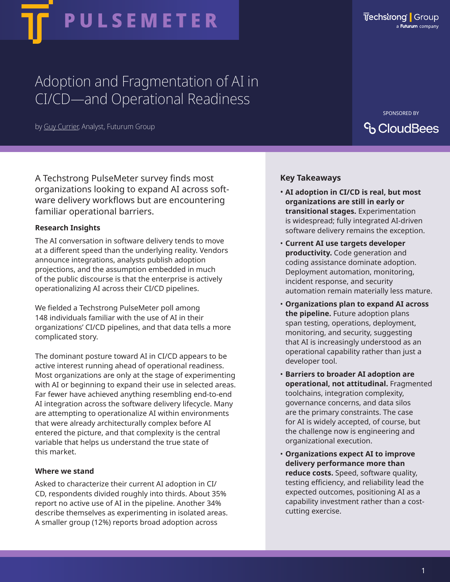
CloudBees PulseMeter Report cover

Download PulseMeter Report


from DevOps.com https://ift.tt/GPfduti

Comments

Popular posts from this blog

One Year Later: How U.S. Winemakers Averted Disaster

One Year Later: How U.S. Winemakers Averted Disaster By Eric Asimov from NYT Food https://ift.tt/32fgBqf Wines, Shutdowns (Institutional), Layoffs and Job Reductions, Quarantine (Life and Culture)

The Agent Failure Your Approval Gate Can’t Catch

An agent that does the wrong thing leaves evidence — a bad diff, a malformed record, a customer complaint. An agent that does nothing and reports success leaves a green checkmark, and green is the one signal your incident process is built to trust. Worry more about the second failure, because everything a DevOps team owns for catching failure — exit codes, run status, alert rules, the dashboard itself — is instrumentation built for software that fails loudly. None of it fires when the failure is an absence. Andrew Filev made the strongest version of the reliability argument in these pages in July ( https://devops.com/reliability-comes-from-the-system-not-the-agent/ ): reliability is a property of the system, not the agent. “Reliability has rarely come from any single component in isolation,” he wrote. “It comes from how systems handle failure.” Aviation does not assume perfect pilots and hospitals do not assume perfect surgeons; both wrap imperfect actors in app...

Future Proofing the Foundation for AI-Ready Security Operations

Last December, the International Telecommunication Union (ITU), the United Nations’ (UN) body for information and communication technologies, supported  Open Cybersecurity Schema Framework (OCSF)  for ratification as an international standard by June 2026. Standardization is now a global necessity as governments worldwide integrate ITU standards into their national cybersecurity policies. First, What is OCSF? The OCSF provides a standardized approach to streamline security operations, improve threat detection, and accelerate incident response. This unlocks the full potential of security data. A standardized schema for security events normalizes data from various sources, which creates a unified foundation for advanced analytics and AI-powered tools. This standardization is crucial for unleashing the full potential of generative AI in cybersecurity, allowing organizations to better identify patterns and correlations across disparate data sources. Data Standardiza...