AI-Assisted Development Under Deadline: What It Takes to Ship Production Code on an Unfamiliar Stack
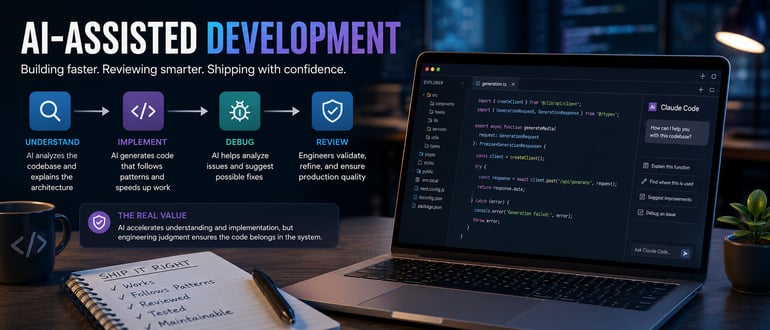

When Photify AI was removed from the App Store, our team had about two weeks to preserve one of its core capabilities: AI-powered photo and video generation. The fastest path was to rebuild that functionality for the web inside Botify AI, a product built on a technology stack I had never worked with before. There was little time to learn the stack from scratch, yet the feature still had to meet production standards.
Claude Code became an important part of that process. It accelerated my understanding of an unfamiliar codebase, generated working implementations and helped resolve issues that would otherwise have taken much longer to investigate. However, writing code turned out to be the easy part. The real challenge was deciding what the generated code should and shouldn’t become.
AI could produce code that compiled, but it couldn’t judge whether it matched the existing system’s architecture, respected established patterns or introduced risks that would surface later in production. Every suggestion still required engineering review, testing and refinement before it was ready to ship.
Looking back, the experience changed my view of AI-assisted development. The bottleneck wasn’t generating code anymore. It was validating that the generated code actually belonged in the system.
The Production Challenge
The removal of Photify AI from the App Store created an immediate engineering challenge. Its AI-powered photo and video generation capabilities needed to be rebuilt for the web inside Botify AI, leaving roughly two weeks from the app’s removal to a live production release.
The compressed timeline was only part of the challenge. Botify AI was built with React, TypeScript and Next.js, technologies I hadn’t worked with before, so there was little opportunity to learn the stack before contributing to production code. At the same time, the implementation had to fit the existing architecture, follow established development patterns and be reliable enough for real users from day one.
Working under those constraints meant balancing speed with engineering discipline. The primary challenge wasn’t simply learning a new stack or meeting an aggressive deadline. It was shipping production-ready code in an unfamiliar environment without compromising maintainability or introducing technical debt. Every implementation decision had to be reviewed carefully, not just to ensure the feature worked, but also to make sure the code integrated cleanly with the existing system and could be confidently supported after release.
Where AI Accelerated Implementation
Working on an unfamiliar stack under a tight deadline shifted much of the challenge from writing code to understanding the existing system. Before a new functionality could be implemented, it was necessary to understand how the application was structured, how different components interacted and where new logic belonged. Navigating an unfamiliar codebase manually would have consumed a significant portion of the project’s already limited timeline.
This was where AI delivered its greatest value. Rather than replacing engineering work, Claude Code accelerated the process of understanding the codebase. It helped explain unfamiliar sections of the application, identify where functionality was implemented and provide the context needed to begin contributing without spending hours tracing dependencies or reading through every file. That faster understanding made it possible to move from exploration to implementation much sooner.
Once the architecture and implementation approach were clear, Claude also accelerated the development process itself. It generated initial implementations, suggested code that aligned with existing patterns and handled many of the repetitive tasks involved in building new functionality. Instead of starting from a blank file, development began with a working foundation that could be refined, reviewed and adapted to fit the surrounding system. The same workflow proved valuable during debugging, where Claude helped analyze errors, suggest possible causes and generate candidate fixes that could then be validated against the application’s actual behavior.
The overall benefit wasn’t that AI produced production-ready software on its own. It reduced the time spent on context gathering, routine implementation and initial investigation, allowing more engineering effort to be directed toward architecture, code quality and production readiness. Under a two-week delivery window, that shift in where time was spent became one of the project’s biggest advantages.
Where AI-Generated Code Created Risk
Working code isn’t always production-ready code. One of the biggest lessons from this project was that AI tends to optimize for solving the immediate problem rather than maintaining consistency across an existing codebase. The generated code often worked, but it still required careful validation to ensure it aligned with established architecture, reused existing abstractions and didn’t introduce unnecessary maintenance overhead.
One recurring issue was consistency drift. AI solves problems locally and doesn’t always recognize that a project already has shared constants, helper functions or established implementation patterns. Instead, it may hardcode values that already exist elsewhere or generate new utilities that duplicate existing functionality. Individually, these changes appear harmless, but across an entire feature, they gradually create multiple sources of truth and make the codebase harder to maintain.
The following example comes from GenerationGallery.tsx, where AI introduced duplicate logic instead of reusing existing helpers.
Before: AI-generated implementation
After: Reviewed implementation
Although the differences are small, they become significant over time. Reusing shared constants and utilities keeps behavior consistent throughout the application and reduces future maintenance. A dedicated consistency review after the feature starts working helps identify these issues before they accumulate into technical debt.
A second risk involved isolation and blast radius. Given access to an entire codebase, AI may attempt to ‘improve’ shared components even when only a single feature requires modification. Those changes can unintentionally affect unrelated parts of the application. To reduce that risk, the new generation feature was developed inside its own isolated directory, while changes to shared services were kept to a minimum and reviewed line by line.
To keep feature-specific changes isolated, the implementation was organized like this.
Feature Directory Structure
Before: AI-generated implementation
After: Reviewed implementation
Keeping feature-specific logic inside the feature reduced the likelihood of introducing regressions elsewhere in the application.
In practice, reviewing AI-generated code wasn’t just about checking whether it worked. It was about deciding whether the implementation belonged in the existing architecture and whether its impact remained appropriately contained.
Ensuring Production Readiness Without Full CI/Test Infrastructure
This project was delivered without a CI/CD pipeline, automated test suite or production monitoring. Rather than relying on automated validation, production readiness depended on disciplined manual testing and careful review of every AI-assisted implementation. Under a two-week delivery timeline, the objective wasn’t to build new engineering infrastructure but to ensure the feature was reliable enough for production using the available processes.
Before release, every major user flow was tested manually on a real device, including scenarios beyond the expected happy path. That process uncovered the most significant issue encountered during development. While rapidly scrolling through a large media gallery, the device became noticeably warm, and the application began to lag. Investigation showed that media items leaving the viewport were not being released from memory, allowing hundreds of objects to accumulate during extended scrolling sessions. This was the kind of problem that would not have been identified through static analysis or code review alone. It only became visible under realistic usage conditions.
Once the root cause had been identified, Claude Code helped implement a solution quickly. After receiving a precise description of the issue that off-screen items were not being released from memory, it generated a working fix within seconds. However, resolving one problem exposed another. Releasing items correctly meant they were loaded again whenever users scrolled back through the gallery, creating unnecessary loading delays. The final implementation combined the memory fix with preloading and properly configured backend cache headers. This allowed media to be reused efficiently without reintroducing the original memory problem.
The most important lesson wasn’t how quickly AI produced the fix. It was what determined whether the feature was actually ready to ship. That discipline remained entirely human: Knowing where to look, reproducing problems under realistic conditions, validating the solution’s effectiveness and deciding when the work was truly complete. AI executed the fix once the problem had been identified, but it didn’t discover the issue or determine that the application was production-ready.
Conclusion
AI-assisted development enabled the delivery of a production feature on an unfamiliar technology stack within a two-week deadline. Claude Code significantly reduced the time required to understand the codebase, generate initial implementations and resolve routine development tasks, allowing more engineering effort to be focused on solving the problems that mattered most.
One of the biggest lessons I took away from the project was that AI accelerated implementation, but it never replaced engineering judgment. Architectural decisions, production validation, risk assessment and the final release decision all remained the engineer’s responsibility. As AI becomes a regular part of software development, the role of the engineer shifts from writing every line of code toward directing, validating and integrating AI-generated implementations.
For DevOps teams, the broader takeaway is that AI can significantly reduce implementation time, particularly under tight deadlines and on unfamiliar technology stacks. However, production readiness still depends on engineering discipline. The biggest challenge is no longer simply writing code. It is determining whether the generated code is appropriate for the existing architecture, reliable under real-world conditions and ultimately ready for production.
from DevOps.com https://ift.tt/k3jXsF0
Comments
Post a Comment