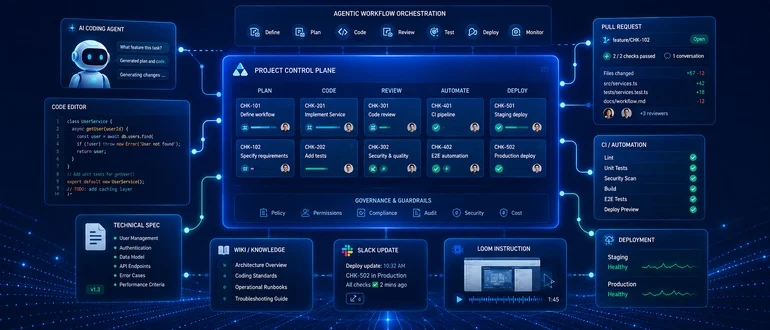

Atlassian today extended the scope of tasks that artificial intelligence (AI) can automate directly from its Jira project management software, including assigning work to an AI coding agent.
Initially, Jira integration with AI coding tools includes Claude Code from Anthropic, Cursor, and GitHub Copilot, with support for Codex from OpenAI forthcoming. Software engineering teams can also leverage the DX AI cost management report tool to unify spend and token data across third-party tools like Claude, Cursor, and GitHub Copilot and Jira projects.
Additionally, Atlassian is embedding a Jira Coding Agent in every paid plan that makes use of the context provided by Jira to convert items into ready-to-review pull requests without requiring developers to set up a local application development environment. At the same time, Jira Planner can now pull from a codebase, Jira and the Confluence wiki tool to define requirements and generate a structured technical specification that either an AI agent or human developer can then use to build an application.
Atlassian is also providing additional hooks between its Teamwork Graph command line interface (CLI) and Jira, along with an ability to automate any business process using coding agents that are invoked via the automation rule builder in Jira. Application development teams, for example, will be able to route bug fixes and updates in the background, with engineers notified when a PR is ready for review.
There is also now an Agentic Engineering project template and a guided setup wizard to help engineering teams stand up agent-ready projects in minutes and is providing tighter integration with the Slack messaging platform from Salesforce.
Finally, Atlassian has updated Loom, a video recording tool, to make it possible to provide AI agents with structured instructions on how to execute a task. Loom captures your screens, clicks, hovers, links, and voice instructions and generates an action plan you can share with any agent or turn into agent-ready Jira work items in a few clicks.
Ming Wu, head of engineering for DevAI at Atlassian, said Jira project management software that is already widely used by DevOps teams is evolving into a platform for managing agentic workflows. Atlassian, in effect, is providing the context layer that enables AI agents to more reliably automate tasks in a way that ultimately serves to also reduce the total amount of tokens that might otherwise need to be consumed, she added.
Mitch Ashley, vice president and practice lead for software lifecycle engineering at the Futurum Group, said the control plane contest for agentic development has moved into the system of record. Atlassian is betting that agent coordination, governance, and evidence belong where engineering work already lives, a claim coding tool vendors are making from inside the developer environment, he added.
Engineering leaders face an architecture decision that goes beyond any single tool, noted Ashley. Where agent work is assigned, governed, and audited determines which vendor owns the agentic substrate, he said.
While the degree to which software engineering teams are embracing AI agents is going to naturally vary, the one thing that is certain is AI agents will soon be pervasively embedded into DevOps workflows. The one that is not clear, however, is how those AI agents will be governed and managed.
from DevOps.com https://ift.tt/WU7q3Sm
Comments
Post a Comment