AI has moved very quickly from experimentation to production. A few years ago, many organizations were still asking whether AI could improve their products or internal workflows. Today, the question is different: how can teams ship AI-enabled software safely, reliably, and responsibly?
That shift matters because AI is no longer just a research project or a boardroom talking point. It is being added to customer support platforms, fraud detection systems, developer tools, compliance workflows, cloud operations, marketing engines, and enterprise applications. The opportunity is real, but so is the risk.
Traditional software usually behaves in predictable ways. If the logic is written correctly, the same input should produce the same output. AI systems are different. A generative AI feature may produce useful answers one moment and questionable answers the next. A model can hallucinate, misread context, expose sensitive information, or make recommendations that sound confident but are wrong.
This is why engineering teams need to move from AI hype to AI assurance.
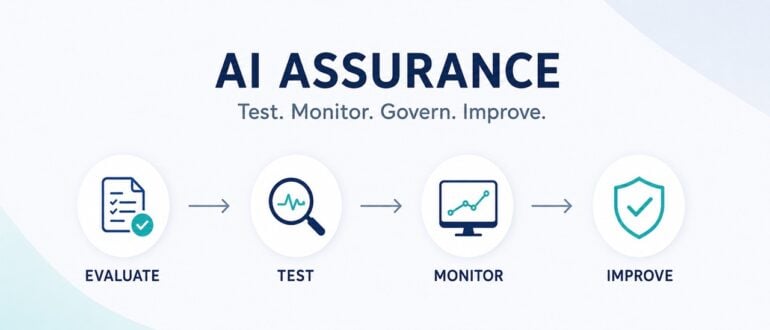
AI assurance is the practice of making sure AI systems are tested, monitored, governed, and improved throughout their lifecycle. It is not about slowing innovation. It is about giving teams the confidence to scale AI without losing control of quality, safety, or trust.
One of the biggest mistakes organizations make is treating AI like a normal feature release. They build a demo, test a few examples, get a good response, and move toward launch. But AI systems need a deeper level of review. A prompt change, model update, data change, or new integration can affect the behavior of the system. What worked yesterday may not work the same way tomorrow.
That means AI testing must become continuous.
Engineering teams should test AI systems for accuracy, consistency, bias, security, hallucination, and failure handling. They should also test edge cases, not just ideal user scenarios. For example, if an AI system summarizes customer complaints, the team must know whether it preserves important details, avoids inventing information, and handles unclear messages properly. If the system is used in finance, healthcare, identity verification, or compliance, the bar must be even higher.
The first step is defining what “good” means. This sounds basic, but many teams skip it. A chatbot, fraud detection tool, code assistant, and recommendation engine should not share the same success criteria. Each AI feature needs clear standards for acceptable behavior, unacceptable behavior, and situations where the system should refuse, escalate, or ask for human review.
The second step is building evaluation datasets. These are collections of real or realistic examples used to test the AI system before release and after major changes. A good evaluation set should include common requests, difficult edge cases, sensitive scenarios, adversarial prompts, and examples where the AI should not answer directly. This gives teams a repeatable way to measure performance instead of relying on a few manual checks.
The third step is adding AI evaluations into CI/CD pipelines. Just as engineering teams run unit tests, integration tests, and security checks before deployment, they should also run AI-specific evaluations before releasing prompt updates, model changes, or workflow modifications. These checks will not make AI perfect, but they can catch many problems before users do.
The fourth step is observability. AI assurance does not stop when the feature goes live. Teams need to monitor how the AI behaves in production. They should track failed responses, user corrections, unusual outputs, latency, cost, model drift, and repeated complaint patterns. When something goes wrong, teams should be able to trace what happened and respond quickly.
Human oversight is also important. Not every AI workflow should be fully automated. In high-risk areas, the better approach is often human-in-the-loop automation. AI can draft, classify, summarize, or recommend, while a person makes the final decision. This keeps speed and judgment working together.
Leadership has a major role to play as well. AI assurance cannot be left only to individual developers. Organizations need clear ownership for model selection, data handling, prompt changes, testing standards, compliance review, and incident response. Without ownership, AI systems can quietly spread across an organization without enough accountability.
The real competitive advantage in AI will not belong only to the companies that ship fastest. It will belong to the companies that can prove their AI systems are reliable, secure, and trustworthy enough to use in real business environments.
For engineering teams, the goal is not perfection. AI will always carry some level of uncertainty. The goal is to reduce avoidable risk, catch failures earlier, and create systems that can be monitored and improved over time.
AI hype may open the door, but AI assurance is what keeps organizations from walking blindly through it.
As AI becomes part of everyday software, assurance will become a core engineering discipline. The teams that build this discipline now will be better prepared to deliver AI products that are not only innovative, but also safe, useful, and trusted.
from DevOps.com https://ift.tt/nc73iEm
Comments
Post a Comment