IBM has rolled out a significant update to Bob, its agentic software development platform, adding multi-agent coordination, built-in spend tracking, and three prebuilt workflows aimed at some of the toughest modernization jobs in enterprise IT: Mainframe COBOL, IBM i, and large Java codebases.
The update lands as most engineering organizations are running into a problem nobody predicted a year ago: AI made writing code the easy part. A recent GitLab survey found that 85% of respondents agreed that AI has shifted the main bottleneck from writing code to reviewing and validating code. IBM cites that same data point in its announcement, and it’s clearly shaping how the company is positioning Bob’s next phase.
Bob isn’t new. IBM introduced it earlier this year as its answer to tools like Claude Code and OpenAI’s Codex, and it made a splash at IBM’s Think 2026 conference, where it reportedly became one of the most talked-about releases on the show floor. Under the hood, Bob doesn’t rely on a single model. It routes coding tasks across Claude, Mistral’s open-source models, and IBM’s own Granite family, choosing whichever fits the job. That routing decision is now central to what IBM is shipping.
Coordinating Agents Instead of Just Prompting One
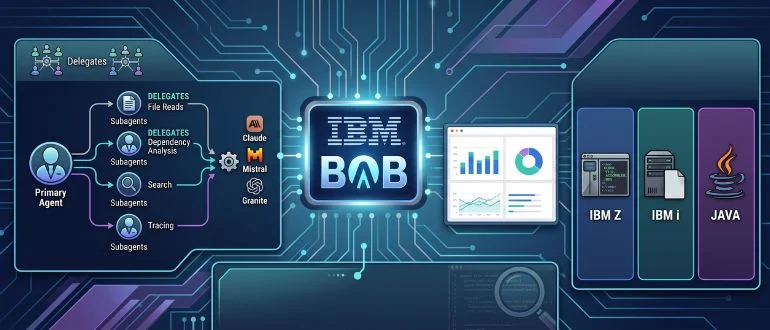
The headline addition is multi-agent, parallel tool calling. Instead of a single model working through a task step by step, Bob can now let a model request multiple tools in the same turn and run them concurrently. IBM also introduced subagents that handle exploratory work, such as file reads, searches, and tracing dependencies, within an isolated context window. That matters because every one of those steps adds tokens, and tokens add cost. Keeping that exploration contained is IBM’s way of preventing routine investigation work from quietly inflating a project’s AI bill.
That cost question gets its own new feature: Bobalytics. It’s a usage-and-spend dashboard built into Bob, giving engineering leaders visibility into consumption, model allocation, and where the budget is actually going. For organizations juggling multiple AI coding tools and multiple models within each one, this is IBM acknowledging a real pain point and picking the right model for a task used to be a manual, ad hoc decision. Bob now tries to automate that tradeoff and show the results.
Modernization Gets Purpose-Built Workflows
The second half of the announcement targets a narrower but higher-stakes audience: teams responsible for legacy systems that most AI coding tools were never built to touch. IBM launched three Premium Packages for IBM Z, IBM i, and Java modernization, each built around structured, repeatable workflows rather than open-ended prompting.
The IBM Z package can reason across COBOL, PL/I, assembler, JCL, CICS, IMS, and Db2, and includes business-rule extraction meant to preserve institutional logic that’s often undocumented after decades of production use. The IBM i package is built around RPG, CL, SQL, DDS, and QSYS-specific tooling. IBM says the Java package handles migration to Java 25, as well as large-scale refactoring and dependency analysis.
IBM points to Blue Pearl, a cloud consulting firm, which says it completed a legacy modernization project originally scoped for 9 months and 14 engineers in 3 days using Bob. Jack Henry, a financial services technology provider, credits Bob with accelerating RPG development and improving code quality across a large, aging codebase.
Those are IBM’s numbers, from IBM’s customers, in an IBM press release, so they’re worth treating as a starting point rather than a verdict. But the underlying problem they’re describing, mainframe and legacy systems that are too risky to touch and too expensive to leave alone, is real and well-documented across the industry.
Why Governance is the Real Story Here
Mitch Ashley, VP and Practice Lead for Software Lifecycle Engineering and AI-Native Software Engineering at The Futurum Group, sees the multi-agent and cost-tracking additions as part of a bigger competitive shift. “Multi-agent coordination paired with a spend dashboard signals platforms competing to own the control plane where model routing, cost, and accountability decisions are made,” Ashley said.
That shift changes what engineering leaders should measure. “The operative metric for engineering leaders is now cost per completed, verified task, and platforms must generate the evidence to measure it,” Ashley said. “Buyers should demand visibility before scaling agent-driven modernization work.”
IBM’s timing lines up with a broader shift in how the industry talks about AI coding tools. GitLab’s 2026 AI Accountability Report found that while 78% of developers report writing and committing code faster with AI, overall software delivery hasn’t sped up at the same rate, largely because testing, review, and governance haven’t kept pace. The same report found that 82% of respondents believe AI-generated code risks creating a new form of technical debt that their organizations aren’t prepared to manage.
Structured, auditable workflows, the kind IBM is building into its Premium Packages, are one direct response to that gap. Whether Bob’s specific approach to governance holds up at scale is something enterprise buyers will need to test for themselves. Still, the direction is consistent with where the rest of the market is heading: Less emphasis on raw code generation, more emphasis on knowing where that code came from and who’s accountable for it.
from DevOps.com https://ift.tt/JTCmG8B
Comments
Post a Comment