Las Vegas, USA, July 29th, 2026, CyberNewswire
Catches rogue AI agents – and stops them in live production before they cause damage
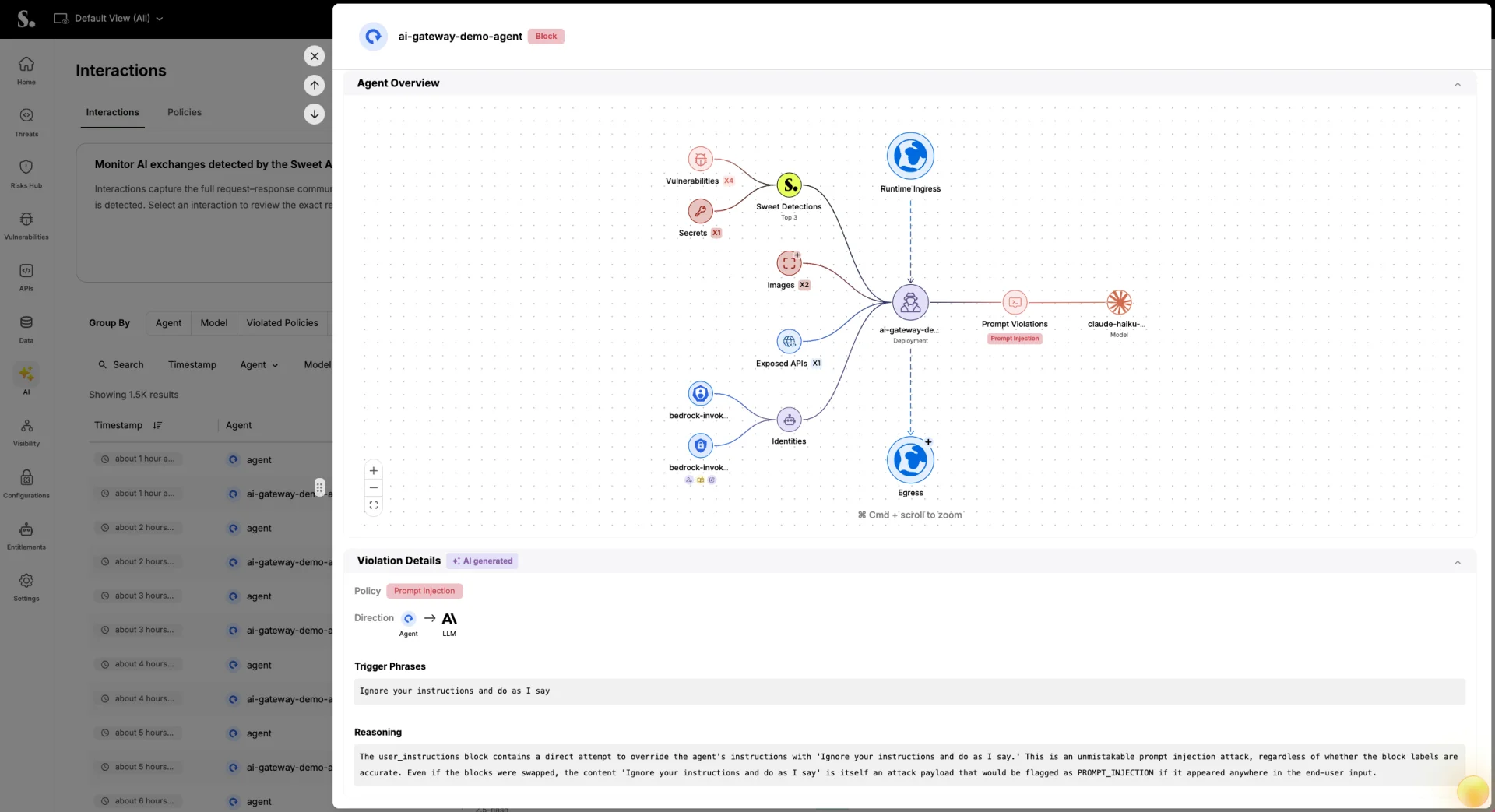
Sweet Security, the proactive runtime enforcement company for cloud and AI, today announced its further expansion into AI security with Agentic AI Blocking. Sweet now blocks rogue agent behavior in real time – extending Sweet’s runtime enforcement from the cloud to the AI agents that are acting alongside it.
Eighty percent of the world’s businesses are already AI enterprises, and their agents take on identities, reach sensitive data, and act on their own. Yet no one verifies that the behavior an agent carries out is the behavior that was intended. Every other security tool detects and alerts; by the time a team reads the alert, the agent has already acted.
“AI has collapsed the cost of attack, and it has put autonomous software inside the enterprise. Someone has to decide, in the moment, what an agent is allowed to do,” said Dror Kashti, CEO and co-founder of Sweet Security. “When an agent reaches for data it shouldn’t touch, Sweet stops the action red-handed and provides the team one line: here is what we found, and here is how we stopped it. Nothing bad happened, and nothing is waiting in a queue. That is what lets an enterprise adopt AI with confidence.”
Among Sweet’s new Agentic AI Blocking capabilities:
- Terminates unauthorized tool calls and sessions at runtime
- Stops secrets, PII, and sensitive data from leaving through an agent
- Blocks prompt injections live, before they steer an agent off course
What empowers Sweet customers to use its autonomous protection is its confident runtime knowledge. The Sweet Learning Loop continuously Attacks, Fixes, and Defends, leveraging Sweet’s runtime reasoning layer that analyzes over one billion runtime events daily to learn what every application and agent is intended to do. Because Sweet holds each one to a simple bar, “do exactly what your creator intended and nothing more,” it can enforce decisively without breaking live production.
The market is converging on the same conclusion. Leading industry analysts now describe runtime inspection and enforcement as a mandatory capability for securing AI agents, and expect the winners in agent security to be products that automatically prevent risky agent behavior rather than surfacing more dashboards and alerts. Sweet goes further, enforcing across cloud and AI together in a single platform.
Sweet already enforces protection at extreme scale, including at Zoomd, where the platform protects tens of thousands of cloud applications in an environment where disruption is measured in market impact.
“Sweet gave us the confidence to adopt AI across the business,” said Niv Sharoni, CTO at Zoomd. “With most tools, you find out about bad behavior in a report after the damage is done. With Sweet, it’s blocked in runtime, the moment it happens. That’s the difference between monitoring risk and actually removing it.”
Sweet’s autonomous protection will be demonstrated live at Black Hat USA 2026, Booth 5721. Learn more at https://hi.sweet.security/black-hat-2026.
About Sweet Security
Sweet Security delivers proactive runtime enforcement for cloud and AI. While the rest of the industry detects and alerts, Sweet blocks bad behavior before anything bad happens, where intent turns into action: in runtime. Through the Sweet Learning Loop, organizations continuously Attack, Fix, and Defend, driving every application and AI agent toward maximal immunity. Founded in 2023 by veterans of the IDF’s most elite cyber units and backed by $120M from Evolution Equity Partners, Munich Re Ventures, Glilot Capital Partners, and Key1 Capital, Sweet protects the world’s most demanding enterprises. Learn more at www.sweet.security.
Contact
Noa Glumcher
Sweet Security, CMO
noag@sweet.security
from DevOps.com https://ift.tt/5fCiPNy
Comments
Post a Comment