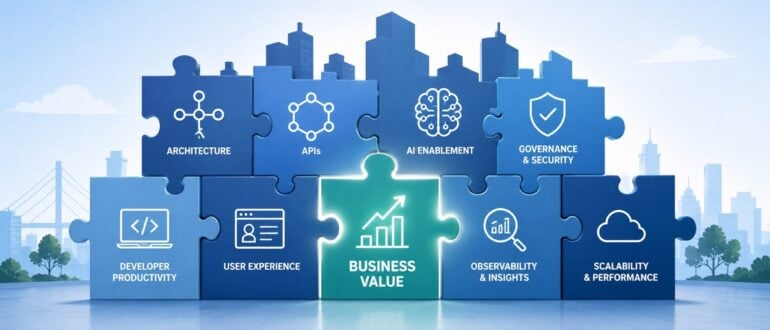

The tech landscape constantly evolves, making it tempting to chase every new trend. Ironically, in today’s business world, the word “innovation” has become almost synonymous with technology adoption. Yet after years of leading digital transformations, I’ve learned that sustainable innovation isn’t about having the latest technology—it’s about solving business problems and delivering measurable impact.
In 2025, the hype was “we’re building an AI strategy.” In 2026, it’s becoming clearer that many of those strategies were more aspirational than actionable—some even serving more as positioning than practical guidance. The latest wave of generative AI has carried a magic-wand promise: that simply generating outputs would unlock transformation overnight. But enterprises are quickly realizing that generating output was never the hard part. The real challenge—and the real differentiator—is governing it responsibly, securing it end-to-end, controlling its behavior, making it cost-effective, and scaling it sustainably across the enterprise.
Building a Foundation for Tomorrow
When executives talk to me about building innovation capabilities, conversations often jump straight to technology investments. While modern tools and platforms play a role, successful organizations understand that innovation is built on a broader foundation. It requires a deliberate balance between modernizing systems, improving experiences, and empowering people. This holistic approach helps organizations avoid the common trap of implementing technology without purpose.
A 2026 enterprise AI adoption study reinforces that the real gap in innovation isn’t experimentation—it’s underestimating foundational readiness across data, architecture, and operating models
Core Modernization: The Technical Base
Most transformation initiatives fail not from choosing the wrong technology, but from not first asking what problem needs solving. The goal isn’t to eliminate all legacy systems—it’s to identify which modernization efforts will drive meaningful business outcomes. One large financial services organization learned this during its AI-driven transformation: before scaling personalized AI recommendations, it first modernized fragmented backend data spread across legacy systems, enabling faster onboarding and improved customer servicing. Success in modernization requires focus in two key areas:
1. System Transformation
Great enterprise technology is never just about what’s under the hood. Apple proved this, their edge was never the most features, but making powerful technology feel effortless. The same holds for enterprise modernization: architecture without adoption is just expensive infrastructure. Enterprises that get this right think in three layers from day one:
Architecture-first → Define how systems connect, where data lives, where AI fits, and how governance is enforced. Every modernization decision that follows should align to this blueprint, without it, teams modernize in isolation and recreate the fragmentation they were trying to solve.
API-first as the connective tissue → APIs are the boundaries between capabilities, not just integration points. Design them to be governed, versioned, secured, and observable. This clean separation also makes the experience layer possible: backends evolve without disrupting what users see, and new experiences are assembled without rebuilding the systems underneath.
Experience Layer: Bridging UX and Business Workflows → A large retail bank improved its digital experience by first building an Experience API layer to unify fragmented backend systems into consistent, real-time customer journeys. This reduced delays in key user flows, significantly improving UX. Mobile app ratings, customer satisfaction scores, and self-service adoption all increased as a result. The key shift wasn’t AI—it was fixing the experience foundation first through APIs.
The experience layer delivers when it gets two things right:
Adaptive interfaces: Personalization and self-service at scale, across roles, contexts, and form factors
Design elegance: Users accomplish tasks without friction; voluntary adoption is the proof
Architecture gives you the blueprint. APIs give you the boundaries. The Experience Layer gives you adoption.
2. Developer Acceleration
AI-assisted development tools have fundamentally changed what “fast” means. With tools like GitHub Copilot and others, generating code is no longer the bottleneck – knowing whether that code is correct, secure, scalable, and architecturally sound is. The risk enterprises face today isn’t moving slowly; it’s accelerating without the controls to ensure what’s being built is the right thing, built the right way.
Real development acceleration means teams can build quickly and confidently. That requires:
Composable platforms with architectural guardrails → assemble capabilities from governed, reusable building blocks validated against your target architecture, security policies, and compliance requirements
CI/CD as a quality and governance gate → automated pipelines enforce code quality, security scanning, dependency checks, and architectural compliance at every commit; this is where accountability lives
Reusable components with clear ownership → components are built with ownership; maintained, versioned, performant, scalable, and accountable
Sustainability and maintainability as non-negotiables → ensuring code remains consistent, modular, upgradeable, and operable at enterprise scale, the bar for what gets merged must go up
The mindset shift: AI tools make developers dramatically more productive. The enterprise challenge is ensuring that productivity compounds, what’s built today must be an asset tomorrow, not a burden.
The ROI of Modern Innovation
Innovation becomes meaningful only when it translates into measurable operational efficiency, stronger customer engagement, and tangible business outcomes.
1. Operational Metrics
AI workflow efficiency → reduction in human effort per process, measured by time and cost at scale
Time-to-market acceleration → from idea to production; how much faster teams deliver validated, production-ready capabilities compared to baseline
Infrastructure and operational cost optimization → cloud spend, API consumption, and AI inference costs managed against delivered business value; scaling output without scaling cost proportionally
2. User Impact
End user adoption → better UX and personalized experiences drive higher engagement, satisfaction, and voluntary adoption
Team productivity gains → teams delivering more, faster, with fewer dependencies and handoffs
Self-service success rate → users independently completing tasks and workflows through the platform without needing support or intervention
3. Business Outcomes
Revenue impact → new capabilities, faster product delivery, and personalized experiences directly enabling new revenue streams or expanding existing ones
Customer satisfaction and retention → experience quality and self-service capability translating into measurable NPS gains, reduced churn, and stronger customer relationships
Operational agility → ability to respond to market changes, launch new capabilities, and adapt to customer needs faster than competitors; the compounding business advantage of a modern foundation
The AMVC Framework: Bridging Intent and Business Impact
Innovation initiatives often stall not from lack of vision or technology, but from the disconnect between AI implementation and measurable business value. Across industries, organizations have successfully launched AI pilots yet struggled to operationalize them securely, responsibly, and at enterprise scale.
After seeing this pattern repeatedly, I advocate a simple but powerful framework – AMVC: Align, Measure, Validate, and Communicate – to bridge the gap between innovation intent and sustainable business impact. It ensures AI investments remain outcome-driven, governable, and adaptable as business needs evolve.
1. Align: Connect AI initiatives to clear business priorities, define governance boundaries and human oversight requirements upfront, establish operational readiness, and secure stakeholder ownership.
2. Measure: Track not just technical performance, but adoption, operational efficiency, customer impact, and business outcomes. Define clear success criteria that include security and compliance adherence. Track unknowns and emerging risks-how an organization identifies, accepts, and systematically eliminates them is a measure of institutional maturity.
3. Validate: Continuously test with end users, monitor AI behavior against defined boundaries, and validate that outputs are reliable, consistent, and trustworthy at scale—not just in the controlled conditions of a pilot.
4. Communicate: Share progress, lessons learned, and measurable outcomes across the organization. Be transparent about what the AI cannot do and where human judgment remains in control. Momentum requires trust, and trust requires transparency about boundaries as much as capabilities.
Building an Innovation Culture That Scales
Technology and frameworks may create the conditions for innovation, but culture determines whether transformation truly succeeds. The most advanced architectures and AI capabilities will fail to deliver value if people don’t trust them, understand them, or feel empowered to question and improve them.
Building a scalable innovation culture requires focus in three areas:
Enable True Collaboration: Innovation cannot live within technology teams alone. Sustainable transformation happens when business, operations, product, risk, and technology teams work through continuous feedback loops. The best organizations make collaboration part of the operating model, not an exception.
Build Capability Through Practice: AI lowers the barrier to building, but raises the bar for judgment. Organizations must invest not only in tools, but in helping teams critically evaluate AI outputs, understand trade-offs, and innovate responsibly. Empower citizen developers with the right guardrails, encourage rapid experimentation, and treat lessons from failure as institutional knowledge.
Take Calculated Risks Responsibly: In 2026, innovation requires balancing speed with discipline. Mature organizations know when to experiment aggressively and when to pause until governance, security, or operational readiness catches up. Leaders who model both create a culture that can innovate confidently and sustainably at scale.
The Path Forward
AI is evolving faster than any single framework, governance model, or technology investment can fully anticipate. That’s not a reason to wait, it’s a reason to build with intention.
The organizations that will lead the next wave of innovation are not necessarily those with the most advanced AI, but those that invested early in the right foundations – architecture, governance, scalability, and experience design – before speed made shortcuts tempting. They built cultures where capability and accountability grew together, and they measured what truly mattered to the business, not just what was impressive to demo.
The innovation puzzle was never just about technology. It has always been about discipline – the discipline to align every investment to a business outcome, validate before scaling, communicate with transparency, and build systems your organization can trust, operate, and evolve.
The pieces are already on the table. The question is whether the foundation exists to bring them together.
The future belongs not to those who chase every trend, but to those who build sustainable innovation capabilities that deliver lasting value.
from DevOps.com https://ift.tt/jV2pK0w
Comments
Post a Comment