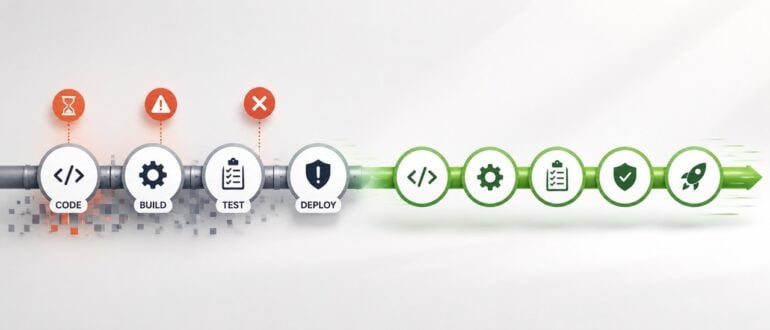
Continuous software delivery in the digital age has come to depend on CI/CD pipelines. They enable engineering teams to rapidly develop, test, and deploy code while keeping it highly usable and consistent across environments. CI/CD pipelines, however, can themselves become a source of friction as systems start at a small scale and become more complex. Pipelines set up to work for small projects have difficulty scaling with ever more repositories, ever larger test suites, and ever larger development teams. Slow feedback cycles, increased infrastructure costs, and decreased developer productivity are some by-products of bad pipeline design.
Here are 10 CI/CD pipeline mistakes that you’ll often come across in your own environment, based on common patterns found across many engineering organizations.
1. Considering CI/CD Pipelines as “Set and Forget”
Some teams set up a CI/CD pipeline at the beginning of a project and then rarely touch it afterward. The pipeline of an application grows as the application grows, but without a plan. Test suites get bigger, more build steps are introduced, and repositories grow larger. But without regular review, the pipelines slowly become slower and more complex.
Frequent monitoring to review pipeline performance should be a team responsibility. CI/CD pipelines should be reviewed and updated along with the underlying software.
2. One Big Monolithic Pipeline
Another frequent mistake is to build a single pipeline in charge of the entire validation and deployment process. Such pipelines frequently integrate linting, testing, packaging, security scanning, and deployment. However, monolithic pipelines are slow and cannot be effectively maintained at scale.
Instead, the scalable approach is to use distinct pipelines designed for different purposes:
- Quick validation pipelines for pull requests
- Extended test pipelines for all merges
- Release deployment pipelines for releases
This structure allows developers to get prompt feedback while still providing strong validation prior to production releases.
3. Inability to Monitor Pipeline Performance
Engineers put a lot of work into observing production systems. However, CI/CD pipelines often lack the same level of visibility. When pipelines slow down or become unreliable, it can be difficult, if not impossible, for a team to answer questions like:
- Which stage of the pipeline takes the most time?
- Which repositories trigger the most builds?
- Where do failures happen most often?
Adding metrics, dashboards, and logs to enable pipeline observability allows teams to identify performance bottlenecks and improve pipeline stability.
4. Heavy Dependency Management Is Responsible for Slow Build Times
Large projects can experience significant delays if they repeatedly download dependencies from external registries during pipeline execution.
Methods that improve dependency performance include dependency caching, Docker layer caching, and artifact reuse between pipeline stages. Even a small improvement in caching can drastically reduce build times.
5. Balanced Testing Is Often the Best
Too much testing or too few tests? The testing strategy has a direct effect on CI/CD pipeline performance. Some teams run the entire test suite on every commit, leading to lengthy feedback cycles. Others do too little CI testing and still require extensive manual verification.
It is recommended to use the following approach:
- Unit tests for every commit
- Integration tests performed on merges
- Full regression tests before release deployments
This approach allows developers to get quick feedback while maintaining software quality.
6. Ignoring Parallel Execution
Many pipelines run tasks in sequence simply because that was the default setup when the pipeline was created.
Modern CI/CD platforms support parallel execution of tasks such as running test suites, building microservices, and performing validation checks. Teams can drastically reduce overall pipeline execution time and speed up development workflows through parallelism.
7. Creating Inconsistent Build Environments
Environment inconsistencies cause CI/CD pipeline failures much of the time. Building locally in one environment while the CI system uses another leads to avoidable failures. Developers often find that code works in their local environment but fails in the pipeline.
Containerized environments or reproducible build environments help keep developer machines and CI systems consistent.
8. Resilient Pipelines Need to Improve
Builds can occasionally be interrupted by network instability, flaky tests, or temporary dependency issues. Without resilient pipelines, failures become more frequent, forcing developers to repeatedly restart builds.
Retry logic for temporary failures, isolation of flaky tests, and clear error reporting mechanisms can help in these situations. Enhanced pipeline resilience reduces unnecessary interruptions in the development workflow.
9. Poor Secrets Management Practices
Security is usually ignored early in CI/CD pipeline development. Credentials might be stored directly in configuration files or environment variables without appropriate safeguards. When CI/CD pipelines share secrets with many services and infrastructure components, secure secret management becomes critical.
Implementing secret management tools and rotating credentials regularly can dramatically reduce security risks.
10. The Developer Experience Is Neglected for Developers
CI/CD pipelines are designed to support developers and accelerate software delivery. When pipelines get slow, unpredictable or challenging to debug, they don’t just disrupt productivity, they stall it.
Good pipelines provide the following things: fast feedback cycles, clear error messages, and predictable execution. When pipelines work well, developers rarely have to think about them.
Final Thoughts
from DevOps.com https://ift.tt/I8EYtLd
Comments
Post a Comment