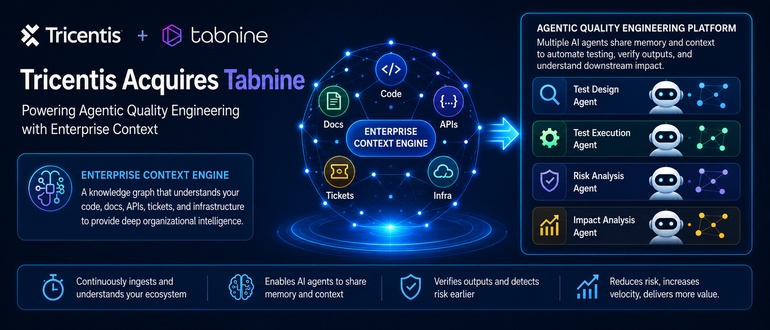

Tricentis today revealed it is acquiring Tabnine to gain access to a knowledge graph that will be used to provide context to AI agents that have been trained to automate a range of testing tasks.
Once the acquisition is complete, Tricentis plans to integrate the knowledge graph developed by Tabnine, dubbed the Enterprise Context Engine, into the company’s Agentic Quality Engineering Platform. Coupled with a vector model, that knowledge graph makes it possible to extract entities, relationships, dependencies, and architectural patterns from repositories, documentation, tickets, application programming interfaces (APIs) and infrastructure metadata in a way that is much easier for AI agents to consume and understand.
The end result will be a platform that continuously ingests code, documentation, tickets, and APIs, providing organizational intelligence in real time and enabling multiple AI agents to share memory and context to both verify outputs and better understand the potential downstream impact of an action.
David Colwell, vice president of AI and machine learning for Tricentis, said that, just as importantly, the capability makes it possible for AI agents to more efficiently test code in a way that serves to reduce the total number of tokens that might otherwise be required.
It’s still early days when it comes to incorporating AI agents into DevOps workflows, but the one thing that is already clear is there is now a greater need to rely on an independent set of AI agents to verify the output of AI coding agents. In some cases, the AI agents performing testing tasks may rely on the same AI model as the coding agents, but as a general rule, the best practice would be to rely on a separate AI model, said Colwell.
Regardless of approach, unless AI agents are integrated into testing workflows, there will be no way for DevOps teams to keep up with the pace at which code is now being generated. The end result would then be more untested code than ever making its way into production environments, which ultimately only serves to increase the total number of incidents that DevOps teams will need to later triage and remediate, noted Colwell.
A recent Tricentis survey finds 60% of organizations already regularly ship untested code into production environments. With more than two-thirds (68%) of organizations having to some degree integrated AI into software delivery workflows, it has only become more probable that untested code is finding its way into production environments. The challenge and the opportunity now is to find a way to reduce that percentage without slowing down the rate at which code is now being created.
There is, of course, a world of difference between shipping code faster and actually delivering more value to the business. The assumption has always been that more code would by definition enable organizations to provide more value to their end customers by delivering more features and capabilities faster. Unfortunately, every time there is an incident it also serves to reduce the return on investment (ROI) from accelerating software delivery in the first place, an issue that in the age of AI has become more concerning as the volume of code being created and deployed exceeds the ability of most DevOps teams to effectively manage.
from DevOps.com https://ift.tt/kEiqYA6
Comments
Post a Comment