Deterministic Robots, Agentic Reasoning: Balancing Reliability and Flexibility in Software Test Automation
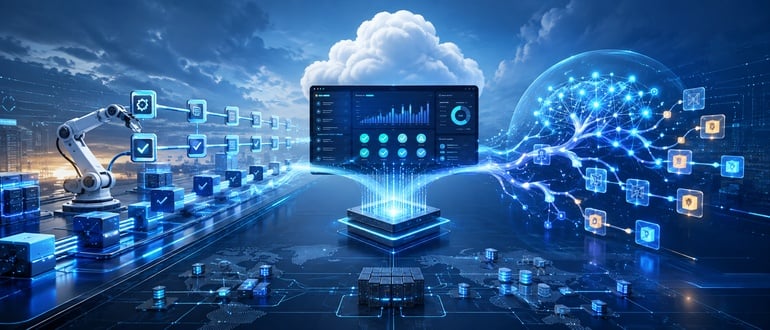

Summary: Scott Robohn explores how UiPath Test Cloud mitigates the “release gap” caused by rapid, AI-driven development by offering a platform that blends a combination of deterministic automation, AI agents, and human oversight.
By distinguishing between deterministic “robots” for efficient, cost-effective regression and flexible “agents” for complex reasoning, the platform empowers quality engineers to use agentic reasoning selectively while managing AI-related consumption and cost.
Drawing on his network engineering background, Scott advocates for adopting these software testing principles to build greater resilience and adaptability within NetDevOps and broader IT infrastructure domains.
Intro
I had the pleasure of serving as a delegate for the UiPath Test Cloud Tech Field Day Showcase. I’ve heard a lot about UiPath from my consulting clients and in the market over the last few years, so I jumped at the opportunity to be a part of the delegate panel and hear directly from UiPath.
Now, let me be clear about something important up front: UiPath is not presenting itself as a NetOps tool for network device config testing or network automation script testing. I say this because you may know me from my consulting work in networking, network automation, and conferences and events that all focus on network infrastructure.
Over the last few years, coming from a “trad” network engineer and architect perspective, I’ve reached the conclusion that network operations and engineering is downstream from software engineering and deployment. DevOps principles make a lot of sense when applied appropriately to Networking, hence the term NetDevOps; leveraging tools like GitHub and other SCCS tools, processes and frameworks like CI/CD, and other tooling are all making lots of sense for NetOps.
As a logical follow-on to that, I’m going out of my way to learn how software testing tools like the UiPath tool suite and principles from the software world can be applied to testing and managing network device config and scripts. UiPath and the delegate panel really helped shed some light on all this for me.
My Takeaways from the UiPath Showcase
The Release Gap
With agentic AI becoming an increasing force in code generation, there is a real and growing “Release Gap” imposed by this ability to write more code quickly. You may have heard people say “Code is Cheap”; but keep in mind that thinking and architecture are NOT cheap. As a result, enterprises struggle to release software with confidence due to slow regression cycles (often 4-6+ weeks) and are still heavily dependent on manual testing. Being able to ship code faster with confidence is clearly a challenge and need.
Josh Duke of UiPath and I had some good interaction over this issue during the showcase. Josh confirmed that the “release gap” is growing because increasing frequency of AI-generated app changes daily or weekly, putting more pressure on quality assurance teams that are, in most organizations, not fully integrated into the modern development lifecycle. He also confirmed that this pressure makes maintaining release confidence more difficult.
Blending Determinism and Non-determinism in a System
Determinism vs non-determinism is an important issue in both software testing and NetOps. Why tolerate non-deterministic mechanisms when I need a deterministic outcome? And why burn tokens on agents leveraging an LLM when you can have a deterministic script/robot run a reliably repeatable procedure? We’re learning to build systems that allow the user to leverage both reasoning (non-deterministic) and reliability (deterministic) to get to the best outcomes in the best ways. And platforms that allow me to control what approach I use in different parts of a workflow are critical.
We had a good discussion about UiPath’s capabilities around “robots” and “agents.” Josh described robots as deterministic automations, similar to the Python scripts we use in NetOps, that follow predefined logic and produce consistent outcomes without requiring LLM inference during the deterministic execution itself. I definitely prefer deterministic results for specific functions.
We’re also finding that agentic reasoning adds value where flexibility is required, much like a Roomba learning to navigate around a couch or coffee table that has just been moved. Josh noted that UiPath Test Cloud gives users the flexibility to choose deterministic automation, agentic execution, or a combination of both, depending on the scenario.
Applying Principles Outside Software Testing
Even though the UiPath tool suite is focused on software dev and test use cases, I got a lot out of the discussion from a strategy perspective. It got me thinking about more connections between software development and tooling and processes for NetOps, reinforcing the connections I see between the disciplines.
This is one of many aspects I love about Tech Field Day events across different IT domains: this cross-fertilization we get from different tooling, approaches, and emergent design patterns. I also see greater opportunity – and need – for us to become systems thinkers regarding our IT stacks versus just separate tech silos. Being able to span different tech categories to better understand how things connect and see application of principles across different categories really helps me think more holistically about IT infrastructure. And I have a growing hunch that AI – as both a thought/architecture partner and more powerful operations tools – will allow us to elevate our thinking and see the whole system more holistically and clearly.
Summing it Up
From my background in network architecture and automation, the hybrid approach between deterministic robots and agentic reasoning is one of the most important aspects of UiPath Test Cloud. There is significant pressure in many IT domains to automate with agents and LLMs, but we shouldn’t accept unnecessary variability or burn tokens on reasoning when a deterministic script or robot can execute a predefined procedure with greater predictability and repeatability
I value when any solution provider gives the user the control to decide where I apply intelligence. Using agents for complex tasks with some ambiguity, while relying on deterministic robots for repeatable reliable heavy lifting, is the kind of systems thinking that is missing from many automation strategies (in networking and other tech domains). This borrowing of software testing principles into other operational domains is how we build more resilient and responsive systems.
Call to Action
If you’re interested in hearing directly from customers and seeing these tools in action, UiPath is hosting their annual event FUSION September 22–25, 2026, at the Wynn Las Vegas.
from DevOps.com https://ift.tt/2IzHnZj
Comments
Post a Comment