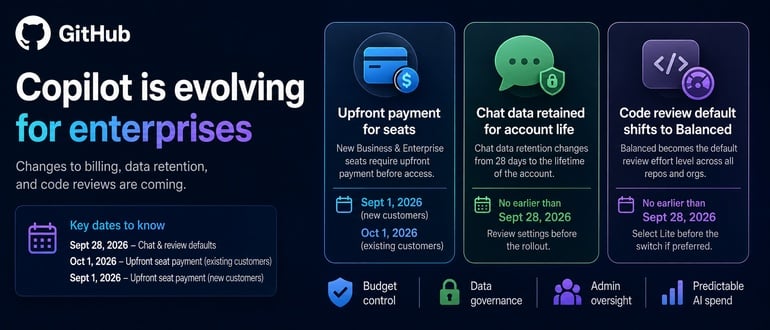

GitHub is changing how organizations pay for Copilot, how Copilot chat handles data, and how code reviews run by default. None of these changes are dramatic on their own. Taken together, they signal something bigger: GitHub is treating Copilot less as a feature bundled into a developer’s toolkit and more as enterprise software that requires the same budget controls, data governance, and admin oversight as everything else IT already manages.
For platform teams and engineering leaders, that shift matters more than any single line item.
The most immediate change hits the wallet. Starting September 1, 2026, new Copilot Business and Copilot Enterprise seat assignments will require upfront payment before a user gains access. Existing customers get a little more runway — the same requirement kicks in October 1, 2026. GitHub says pricing itself isn’t changing, and seat revocation still won’t trigger a refund. But the mechanics are different: organizations will be charged for assigned seats at the start of each billing cycle, with additional charges if usage runs past what’s included, and included usage may be prorated monthly. GitHub frames this as an effort to “strengthen account vetting” and improve availability and reliability. Read between the lines, and it also looks like a response to how unpredictable Copilot costs have become since the platform moved to usage-based, token-driven billing back in June. That earlier switch replaced the old premium-request model, where every model interaction consumed a fixed unit regardless of how much it actually cost to run. Under the new system, cost depends on the model and the number of tokens an interaction actually consumes, which is much harder to forecast in a spreadsheet built for flat per-seat pricing. Admins who have gotten comfortable adding and removing seats on the fly will need to rethink how they manage that process, especially at the start of a billing cycle.
The second change is about chat, and it’s the one compliance teams will care about most. GitHub is merging Copilot Cloud Agent, the chat experience on github.com, and GitHub Mobile Chat into a single, unified experience, rolling out no earlier than September 28. That consolidation comes with a policy change buried in the details: chat data, which used to have a 28-day retention limit, will now be kept for the lifetime of the account. That’s a meaningful shift for any organization with data retention policies, audit requirements, or contractual obligations regarding how long AI-generated conversations persist. GitHub is telling business and enterprise admins to review the unified policy and confirm their settings before the rollout, which is really a polite way of saying: don’t get caught flat-footed by a default you didn’t choose.
The third change is smaller but still worth flagging for anyone running Copilot code review at scale. The default review effort level is shifting from “Lite” to “Balanced” across all repositories and organizations, also effective September 28. Teams that want to keep the lighter-touch review behavior will need to explicitly select Lite before the switch happens. It’s a small setting, but it changes the volume and depth of feedback Copilot generates on every pull request — which affects both review time and the number of tokens consumed under the new usage-based billing model.
That’s the connective tissue here, and it’s not lost on analysts watching the AI tooling market. Mitch Ashley, VP and practice lead for software lifecycle engineering and AI-native software engineering at The Futurum Group, put it plainly:
“Charging upfront for seats and metering tokens is how a vendor prices a product whose per-seat value is under pressure while its consumption climbs,” Ashley said. “The governance defaults matter more. Chat retention moving to the life of the account, and code reviews getting deeper by default, are settings that decide both audit exposure and monthly cost. Engineering leaders should assign an owner to those defaults now, before the invoice makes the decision for them.”
None of this should surprise anyone who watched GitHub retire premium-request billing in favor of token-based pricing earlier this year. That move alone caused plenty of budget headaches for teams that hadn’t built AI spend into their forecasting, and it wasn’t unique to GitHub — most vendors selling agentic AI tools have run into the same problem as usage shifts from predictable seat licensing to variable, consumption-based pricing.
Ashley’s advice points to a calendar, not just a mindset. Whoever owns Copilot administration should review the new billing cycle mechanics before October 1, loop in data governance before the chat consolidation lands September 28, and decide deliberately whether Balanced or Lite code review fits how their teams actually work — rather than letting the default decide for them.
Copilot adoption has moved fast inside most engineering organizations over the past two years. Governance and cost controls are only now catching up. That catch-up process is going to keep producing changes like this one — not flashy new features, but the unglamorous plumbing of accounts, billing cycles, and data retention that determines whether an AI tool scales cleanly or turns into a budget surprise. Organizations that get ahead of these settings now will spend a lot less time explaining an unexpected invoice or a policy gap later.
from DevOps.com https://ift.tt/pEQHwu5
Comments
Post a Comment