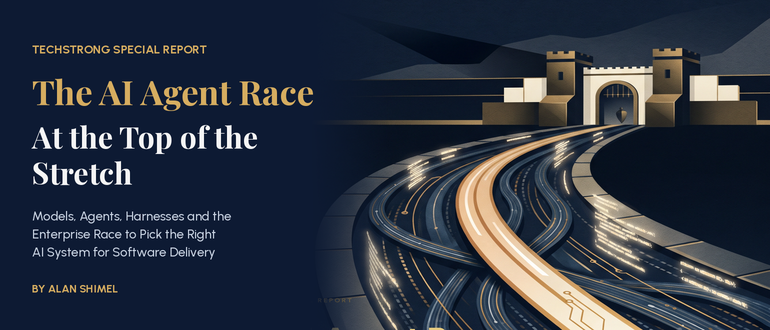

Claude Code, OpenAI Codex, GitHub Copilot, Cursor and a growing field of challengers are competing to define the future of software development. A new Techstrong special report examines who is ahead, how the race should be measured and what enterprises need to consider before placing their bets.
Which AI coding agent is winning?
It sounds like a simple enough question. Claude Code has surged among professional developers. OpenAI Codex is gaining ground quickly. GitHub Copilot enjoys enormous distribution and sits inside the repository and pull request workflows enterprises already use. Cursor has emerged as an agent-native development environment. Google brings powerful models, cloud infrastructure and developer reach. Devin and other specialists are pursuing longer-running autonomous work, while open source projects such as OpenHands, Cline, OpenCode and Aider give organizations more control over models, data and deployment.
There is no shortage of contenders. There is also no shortage of numbers supposedly telling us which one is ahead.
The problem is that those numbers are frequently measuring different things.
Model-routing platforms measure token traffic. Developer surveys measure which products their respondents say they use. Enterprise surveys measure which foundation models organizations have placed into production. Benchmarks measure the performance of a specific model operating inside a specific harness, with a particular set of tools, instructions, compute resources and time limits. Customer stories show what one organization accomplished with one implementation.
All of that evidence is useful. None of it, taken alone, gives us a universal market-share table for AI coding agents.
That is why Techstrong’s new special report, “The AI Agent Race: At the Top of the Stretch,” starts by separating the races before attempting to handicap the field.
DOWNLOAD THE FULL REPORT (PDF)
A Fast-Moving Field
There is little doubt that AI coding agents have moved into the mainstream of software development.
A 2026 JetBrains survey of more than 15,000 professional developers found that 90% used AI coding agents at work at least weekly, while 68% used them daily. Claude Code was used at work by 39% of respondents, up from 18% in January. Codex rose from 3% to 16% during roughly the same period.
Other evidence reveals a different picture. Futurum research found OpenAI, Azure OpenAI and Google Gemini widely used as production model providers across enterprises. Anthropic’s share at the foundation-model level was considerably lower than Claude Code’s position in developer surveys.
Those findings are not necessarily contradictory. An enterprise might use OpenAI models in a customer-facing application, Gemini for data analysis and Claude Code for software development. It might access Claude through GitHub Copilot or Cursor rather than through Anthropic’s own interface. It may use one agent in the IDE, another in the terminal and an internally developed system for background work.
The model, agent, development environment and enterprise platform are becoming increasingly difficult to separate. They are also not always purchased from the same vendor.
That makes this a much more complex contest than the usual horse-race coverage suggests.
Assistance Is Not Autonomy
The other complication is that nearly everything is now marketed as “agentic,” even though most enterprise adoption remains concentrated in assisted rather than autonomous work.
Futurum’s software lifecycle research found individual developer assistance to be the dominant mode of AI use at 47.20%. Supervised agents accounted for another 18.36%, while semi-autonomous agents stood at 13.59%. Autonomous, end-to-end agents represented only 5.84%.
The same boundary appears when we examine where AI is being used across the software lifecycle.
AI was used for code generation by 40.17% of respondents and code review by 37.66%. Adoption fell to 28.01% for testing, 20.98% for observability, 16.21% for incident response and 13.23% for CI/CD operations. Only 6.20% reported using AI in deployment decisions.
Enterprises are clearly willing to let AI help create and review a change. They become more cautious as an agent approaches infrastructure, credentials and production.
That caution does not mean the autonomous software delivery vision is dead. It means that every increase in autonomy also increases the potential consequences of failure.
A bad code suggestion can be rejected. A bad commit can be reverted. An agent with access to secrets, infrastructure or a production deployment pipeline can cause damage before a person understands what it has done.
The report examines this widening gap between agent capability, enterprise authority and the controls organizations have actually deployed. Some of the findings should give DevOps, platform engineering and security leaders pause.
The Leaderboard Can Mislead
Public benchmarks remain an important part of evaluating coding agents, but they can create a false sense of precision.
A benchmark score does not belong to the model alone. It reflects the model, the agent harness, the available tools, the task design, the execution environment and the resources the system was allowed to consume.
Change the tool interface and an agent may complete more tasks while using fewer tokens. Change the compute or memory allocated to the environment and leaderboard positions may shift. Use a familiar public repository rather than an undocumented internal codebase and the benchmark may tell an enterprise very little about how the agent will perform on its own work.
The report looks at recent questions surrounding SWE-bench Verified, the emergence of SWE-Bench Pro, Terminal-Bench and evidence showing how infrastructure and purpose-built tools can materially change agent results.
It also examines the cost question, which has become almost as confusing as performance.
A monthly seat price, token rate or premium-request allowance does not tell a software organization what useful agent work costs. The real calculation includes inference, compute, tools, retries, human steering, review, rework, defects and rollbacks.
The least expensive model may generate the most expensive pull request.
Picking the Right Horse for the Course
The AI agent market is beginning to take shape, but it is far from settled.
Claude Code, Codex, GitHub Copilot, Cursor, Google, autonomous specialists and open harnesses each enter the race with different advantages. One may lead in reported developer adoption. Another may control the workflow through which enterprises accept and govern changes. A third may provide the model portability or data sovereignty required by a regulated organization.
There may be leaders, but it does not follow that there will be one winner for every kind of software work.
“The AI Agent Race: At the Top of the Stretch” examines the field, the evidence behind the claims, the gap between assistance and autonomy, the limitations of public benchmarks, the economics of agentic development and the questions enterprises should ask before expanding an agent’s authority.
It also offers a practical framework for evaluating these systems against an organization’s own code, workflows, risk tolerance and definition of a successfully completed task.
I will save the report’s final handicapping for the report itself. It is available ungated, so you can read it without surrendering your email address or waiting for someone to call.
Ask Patrick Debois Anything, Live at DevOps Experience
The report is being published in support of DevOps Experience 2026, and we are adding a special session worthy of the occasion.
Patrick Debois, the man who coined the term DevOps and helped launch the movement, will join us for a live AMA. Patrick will be joined by Futurum’s Mitch Ashley and several surprise DevOps experts for a wide-ranging, unscripted conversation.
This is your opportunity to ask Patrick and the panel about where DevOps goes from here. Bring your questions about DevOps, AI-native development, coding agents, platform engineering, software delivery, the changing role of developers or anything else shaping the next era of the movement.
The report frames many of the questions the industry now needs to confront. At DevOps Experience, you will have the chance to ask them directly of the person who helped start the conversation.
Download the ungated Techstrong special report, “The AI Agent Race: At the Top of the Stretch,” and register for DevOps Experience 2026 on Sept. 24, 2026.
The field is coming into view. The finish line is not, and the people who helped define DevOps will be with us to discuss what comes next.
from DevOps.com https://ift.tt/n8Aqkst
Comments
Post a Comment