
Anyone who has run more than one Claude Code session at a time on the same codebase already knows the drill. You split the work yourself, decide which session touches which files, track what each one is doing, and then stitch the results together by hand. The model can write good code in parallel. Coordinating that parallel work has been left entirely to humans.
Anthropic is trying to close that gap. On September 17, the company rolled out a redesign of Claude Projects that moves it from a static container for files and chat history into something closer to a project manager: A coordinator that breaks a stated goal into parallel threads, delegates the work, and assembles the results.
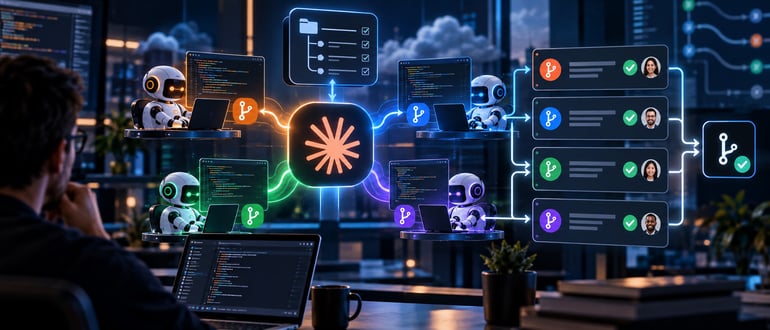
The mechanics are straightforward once you see them. A user states a goal and connects the relevant repositories or context, and a coordinator thread scopes the work and spins up worker threads to handle pieces of it. Each of those threads runs as a full Claude Code cloud session on its own branch, and can spawn its own subagents, loops, or workflows for anything complex enough to need them. Anthropic’s own examples give a sense of the target workload: Optimizing checkout latency across a set of endpoints simultaneously, or retiring a deprecated API across every repository that still calls it. Both are the kind of job that’s conceptually simple and logistically annoying — exactly the annoyance this redesign is aimed at.
Merges are handled through standard pull requests, which matters more than it sounds like it should. Anthropic isn’t asking teams to trust a black box to push straight to a branch; it’s asking them to review PRs the way they’d review PRs from a very fast, very literal junior engineer working several threads at once.
The other piece worth paying attention to is memory. Instead of every session starting from zero, context now persists across the threads in a project — deadlines, technical decisions, communication preferences, the fact that the release moved to Friday. Anthropic frames this as cutting down on prompt engineering, and for teams running the same project over weeks or months, that’s a fair description of the actual pain point: re-explaining context to a fresh session every time is tedious and error-prone. A project library rolls uploaded files and Claude-generated artifacts into one place alongside that memory, so the output of one thread is easier for the next one to find and build on.
None of this runs unsupervised by default. Anthropic built in controls for how much autonomy the coordinator gets — how often it checks in, how aggressively it spins up new threads, how much detail it surfaces in updates — and users can work from the main project chat for a high-level view or drop into an individual thread when they need to steer something directly. Projects are also reachable from a phone, which matters less for the coding itself and more for the review-and-approve loop that keeps someone in the chain.
The rollout is staged, which matters for anyone tracking whether this is ready to lean on. The beta starts with Claude Pro and Max subscribers running cloud sessions in Claude Code who don’t already have projects set up on web or desktop. Anthropic says a wider release to chat, Cowork, and Team and Enterprise plans is coming in the following weeks. That’s a reasonable way to ship something that changes how merges happen — test it with the users most likely to notice if a coordinator mis-scopes a task before handing it to people managing production branches.
Mitch Ashley, vice president and practice lead for CIO & Technology Buyers and Software Lifecycle Engineering at The Futurum Group, sees the shift to PR-based merging as the detail that will decide how fast this gets adopted. “Running work in parallel is the easy part to sell,” he said. “The part that actually earns trust is that every thread still lands as a pull request someone reviews. That’s the difference between a tool platform teams can adopt on their own terms and one they have to fight to keep visible.”
That’s the right frame for a DevOps audience to apply here. Multi-agent orchestration has been the direction the whole agentic AI conversation has been heading for the past year, and Anthropic just shipped a version of it wrapped around a workflow developers already know: branches, PRs, review gates. The interesting question isn’t whether Claude can split a task into three threads and run them at once — plenty of tools can already fan work out. It’s whether the coordination logic deciding what to delegate, when to merge, and what counts as done holds up the way a human tech lead’s judgment would, across a codebase messier than any demo. That’s an operational question, not a modeling one, and it’s the one platform teams evaluating this should be asking first.
from DevOps.com https://ift.tt/F6AtJlE
Comments
Post a Comment