
Perforce Software has added a tool that leverages artificial intelligence (AI) to make it simpler for application development teams to generate synthetic data for application testing purposes.
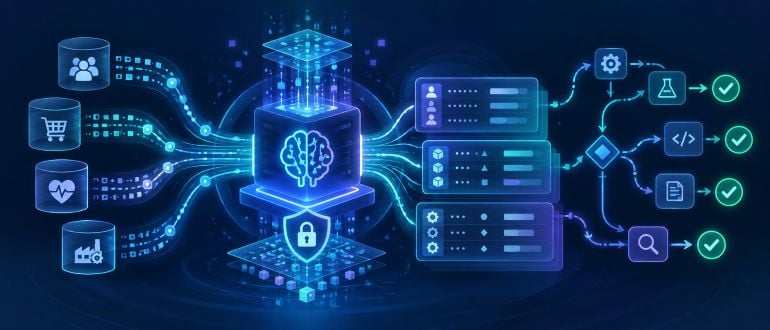
Mayank Ahluwalia, a senior product manager for Perforce Delphix, said Delphix Synthetic Data makes use of machine learning algorithms to generate synthetic data for specific use cases. It automatically identifies data structures, relationships, and business context across multiple sources.
Historically, DevOps teams would have had to manually provide access to those data sources using some type of legacy tool, he added.
The overall goal is to limit or eliminate the need to give application development teams access to production data in order to test an application, noted Ahluwalia. At the moment, providing those teams with access to data needed to run tests has become a bottleneck that can be eliminated by using a self-service platform for generating synthetic data, he added. That capability will be especially critical as AI agents are relied on more to create and run those tests, said Ahluwalia.
In far too many instances, the data being used to test applications is not especially useful. In fact, a recent Perforce survey finds only 34% said synthetic data provides referential integrity and only 36% said it provides data realism. Machine learning algorithms that have been trained specifically to generate synthetic data typically generate synthetic data that can be much more closely aligned with a specific use, said Ahluwalia.
DevOps teams can then more easily decide what mix of synthetic and masked data can be used to create tests that better reflect the actual environments where code will run, he added.
Delphix Synthetic Data is designed to enable both human developers and AI agents to access data via a graphical user interface, application programming interfaces (APIs) or the Model Context Protocol (MCP). DevOps teams can then also load that data into the large language model (LLM) of their choice to generate tests to better control costs, noted Ahluwalia.
It’s not clear at what pace DevOps teams are now applying AI to application testing. However, as it becomes easier to generate those tests, the overall quality of the applications being built and deployed should improve. In the meantime, however, the pace at which code is being generated in the AI era is now in many organizations overwhelming existing workflows for testing applications. More often than software engineers may care to admit, even more code that has not been properly vetted is now as a result running in production environments. As a result, it’s little wonder that the number of issues that DevOps teams are encountering after an application has been deployed in the AI era are, instead of decreasing, actually increasing.
Hopefully, there will soon come a day when the state of the art of AI testing catches up to the rate at which AI tools are being used to generate code. In the meantime, however, DevOps teams are likely to have their hands full until a complete agentic approach to managing the software development lifecycle (SDLC) is adopted.
from DevOps.com https://ift.tt/mkcZpwN
Comments
Post a Comment