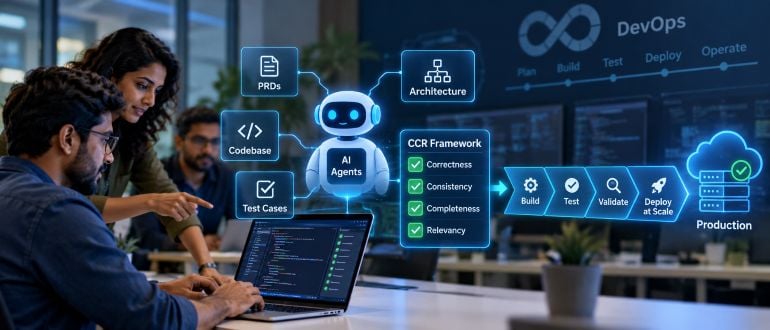

Talentica Software this week launched a managed software delivery service that leverages artificial intelligence (AI) to enable DevOps teams to deploy applications developed using AI coding tools at scale.
Company CTO Manjusha Madabushi said the DevX AI Pods service makes use of a set of AI agents that Talentica has trained to provide the context needed to successfully build and deploy applications using AI tools. Those agents analyze existing artifacts such as product requirement documents (PRDs), the codebase, test cases, and the underlying software architecture to ensure that the application developed using AI tools can actually run in a production environment, she added.
Specifically, AI agents leverage a Correctness, Consistency, Completeness and Relevance (CCCR) framework that Talentica developed to evaluate the code being created. That output is then validated by a team of more than 600 Talentica software engineers to ensure it meets the original criteria specified.
That approach enables AI agents to more holistically reason about the changes rather than implementing each one independently, said Madabushi. AI agents, for example, can map dependencies, reuse existing functionality, and perform root-cause analysis on failures.
The overall goal should not be to simply generate code quicker but rather to enable DevOps teams to reliably deploy higher-quality applications at a much faster rate, noted Madabushi. The issue that far too many DevOps teams are encountering is that while AI coding tools make it possible to generate more code than ever, they are not actually increasing the rate at which applications are deployed, she added. Additionally, AI tools tend to create a lot of duplicate code that eventually creates a level of bloat that impacts application performance, noted Madabushi. In effect, AI coding tools are actually increasing the amount of technical debt that DevOps teams need to eventually retire, she noted.
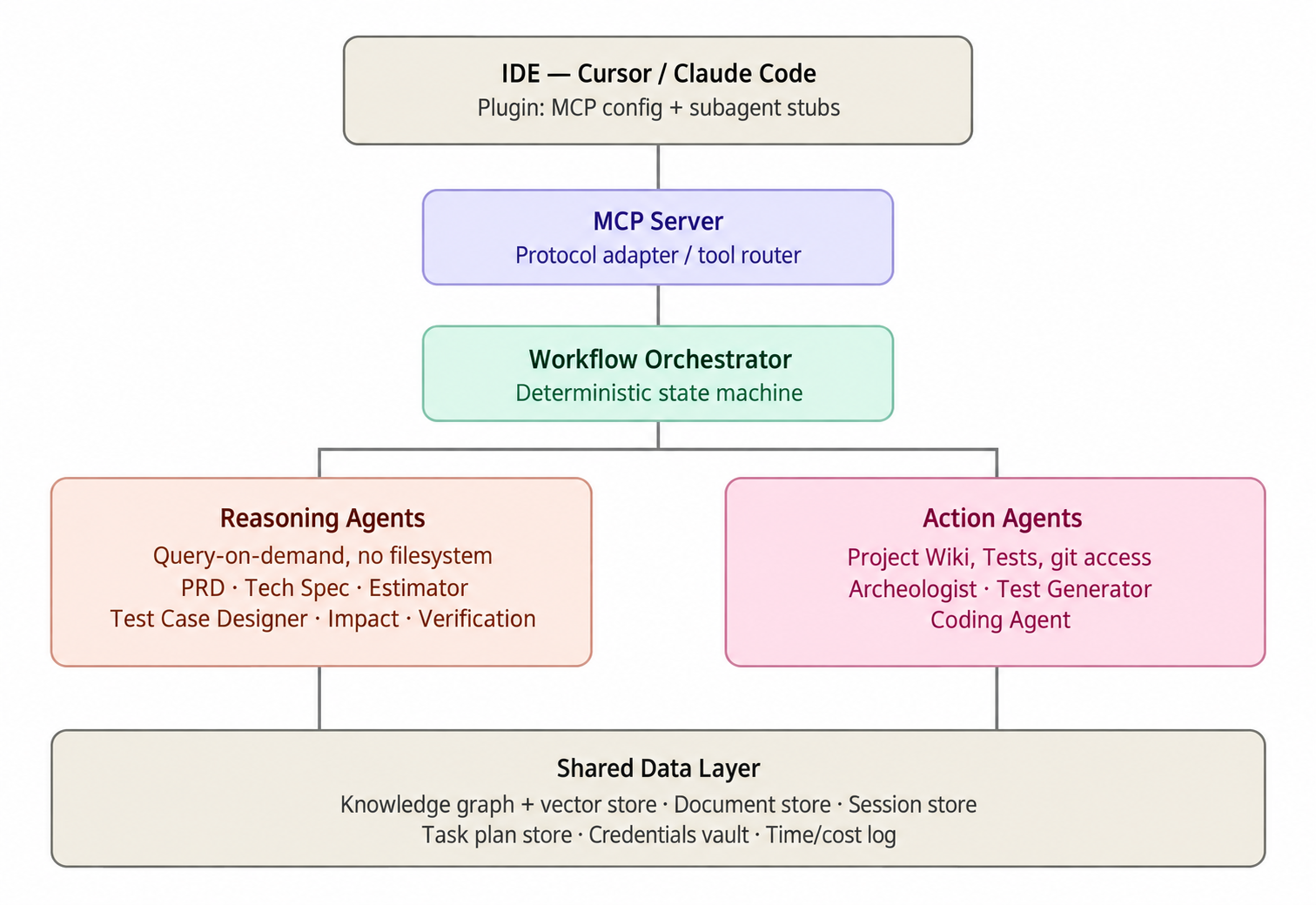
It’s not clear at what rate the rise of AI has actually resulted in more applications being deployed faster but there is clearly now no shortage of code. A recent Futurum Group survey found more than half (54%) now work for organizations that use AI across more than half of their software development lifecycle (SDLC), with 40% reporting AI already generates the majority of production code merged in the last 90 days. Within the next three years, a total of 58% expect AI to build 80% or more of their software. However, three-quarters of survey respondents (75%) have encountered a production issue that they have confirmed is attributable to AI, with 42% experiencing multiple incidents.
The challenge, of course, is that it’s difficult to determine how much of that code is making it into production environments and, potentially more troubling, was it validated before being incorporated into a software build. Each DevOps team will, of course, need to decide how best to manage the volume of code now being generated in the AI era. There is, at this point, little doubt that achieving that goal will require more reliance on AI to resolve all the coding issues now being created by AI.
from DevOps.com https://ift.tt/GBD1Fhl
Comments
Post a Comment