
AI agents are becoming operational teammates. They can ingest alerts, query logs and traces, correlate deployment events, consult runbooks and recommend or perform remediation. Their promise is not merely faster summarization: It is a shorter path from detection to safe recovery.
But an agent that can explain an incident is not automatically an agent that should change production. Restarting a stateless pod, rolling back a customer-facing payment deployment and responding to a suspected credential compromise are materially different decisions. Each requires a different amount of evidence, human accountability and execution control.
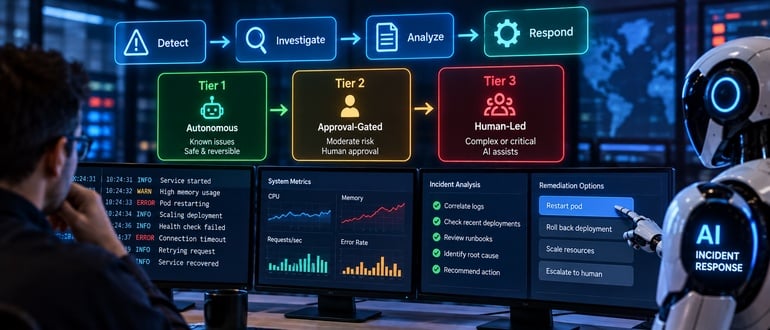
The practical answer is tiered autonomy. Tier 1 automates well-understood and reversible incidents. Tier 2 lets the agent investigate and recommend, while a human explicitly approves the action. Tier 3 keeps people in command for novel, complex or high-impact incidents while the agent accelerates evidence collection and hypothesis testing.
The three tiers of agentic incident response match an AI agent’s permissions to incident familiarity, blast radius, reversibility and diagnostic confidence. Tier 1 is autonomous remediation for proven runbooks; Tier 2 is approval-gated action for moderate-risk cases; Tier 3 is a human-led investigation supported by an AI agent.
Why Tiered Autonomy Works
The wrong framing is ‘full automation versus no automation’. Full autonomy can amplify a mistaken diagnosis across production. A read-only chatbot, meanwhile, leaves most repetitive operational work with the on-call engineer. Tiered autonomy makes automation earned, bounded, observable and reversible.
People are using tools such as Aiden for SRE, AWS DevOps Agent and Azure DevOps Agent to automate RCA and reduce MTTR.
For each incident type, assess four questions before determining its tier:
- Is the failure pattern well understood and represented by an approved runbook?
- What is the maximum plausible blast radius if the diagnosis or action is wrong?
- Can the action be reversed quickly and safely?
- Is the agent’s decision supported by sufficient evidence and historical success?
| Decision Factor | Tier 1: Autonomous | Tier 2: Approval-Gated | Tier 3: Human-Led |
| Familiarity | Frequent, repeatable pattern | Known pattern with meaningful variation | Novel, ambiguous or conflicting signals |
| Blast Radius | Single workload or bounded component | Single service or limited customer impact | Cross-service, security, regulatory or business-critical |
| Reversibility | Fast and automated rollback | Reversible but needs observation | Difficult, costly or irreversible |
| Confidence | High and evidence-backed | Moderate; competing explanations exist | Low or no validated precedent |
| Human Role | Review after the event | Approve the proposed action | Lead decisions and direct investigation |
The exact thresholds will vary by organization. A useful starting point is to reserve autonomous action for runbooks with a strong historical success record and deterministic verification, require approval for anything that changes a customer-facing service and make security, data and multi-service failures human-led by default.
Tier 1: Autonomous Response
Tier 1 covers known-knowns: Common failures with an explicit, tested and reversible remediation path. The agent can execute because it is operating inside a narrow contract, not because the model has broad authority.
What Qualifies for Tier 1?
- The alert signature and diagnostic evidence match a known runbook.
- The affected resources are explicitly allowlisted.
- The action is reversible, idempotent and limited in scope.
- Success can be verified through objective telemetry.
- A failed verification automatically stops further action and escalates the incident.
Sample use Case: Bad Container Image Rollback
An orders API deployment introduces an invalid image tag. Kubernetes reports ImagePullBackOff; the new ReplicaSet cannot become ready and the prior revision was healthy. This is a good Tier 1 candidate only if the service is stateless, the previous revision is known-good and rollback is pre-approved.
- The agent receives the deployment-readiness alert and gathers Pod events, the current image reference, rollout history and recent change metadata.
- It confirms the ImagePullBackOff condition, verifies that the prior revision was healthy and validates that the service is on the Tier 1 allowlist.
- It executes a bounded rollback to the previous revision.
- It verifies that desired replicas become ‘ready’ and that error rate and latency return to normal within a defined window.
- It posts a concise incident record with evidence, action, result and rollback status.
In a manual workflow, this can take 30–60 minutes when an engineer is paged, collects context, confirms the change and executes the rollback. With a tested autonomous workflow, detection, rollback and verification can complete in a few minutes. Microsoft describes customer-controlled autonomy options for Azure SRE Agent and has published examples of alert-to-verified recovery workflows for AKS.
Sample use Case: Bounded Scale-Out
A checkout service experiences a predictable campaign-driven increase in queue depth and CPU utilization. The agent is allowed to scale replicas from three to a maximum of eight, but cannot change resource requests, cluster capacity or autoscaler configuration.
- Trigger: CPU remains above 80% and queue depth rises for five consecutive minutes.
- Evidence: Request rate, queue depth, pod readiness, node capacity and error rate support the scale-out diagnosis.
- Action: Raise replicas within the approved minimum and maximum range.
- Verification: Queue depth declines, CPU stabilizes, error rate remains within SLO and new replicas are ‘ready’.
- Stop Condition: Insufficient node capacity, failed readiness or repeated scale actions forces escalation.
This saves minutes rather than hours, but it also prevents the familiar 3 a.m. delay between a clear alert and a low-risk operational change. The value of Tier 1 is consistent execution of boring, repeatable work — not heroic automation.
Tier 1 Guardrails
- Least Privilege: Use service accounts scoped to named namespaces, resource kinds and verbs.
- Blast-Radius Caps: Limit concurrent actions, replica ranges, clusters and services.
- Cooldowns: Prevent repeated restarts or scaling oscillation for the same workload.
- Circuit Breakers: Disable the runbook after repeated verification failures or unusual error-budget burn.
- Immutable Audit Logs: Preserve the incident evidence, proposed plan, executed command, result and agent identity.
Tier 2: Collaborative Diagnostics
Tier 2 covers known-unknowns. The agent has useful evidence and a plausible remediation, but uncertainty, customer impact or a non-trivial rollback requires explicit human approval. Tier 2 is frequently the fastest path to value because it removes investigation toil without giving away operational accountability.
What Qualifies for Tier 2?
- The agent can form a credible, evidence-based hypothesis, but alternatives remain.
- The action is reversible but may interrupt users, workloads or in-flight transactions.
- The service is customer-facing or important enough to require a named approver.
- The runbook is approved, but context determines whether it is appropriate to execute.
- The agent can show the evidence, expected outcome, risks and rollback plan in an approval request.
Sample use Case: Database Connection-Pool Exhaustion
An orders service starts returning 503s. Connection-pool utilization is 100%, database wait time has increased sharply and a small number of long-running queries are visible. However, the root cause could be a slow query, a connection leak or a sudden traffic increase. The agent should not terminate database sessions on its own.
A high-quality Tier 2 approval message should be structured, not conversational.
- Incident: Orders-api elevated 503 errors.
- Evidence: Connection pool is saturated, pool wait time is 10x baseline and three active queries have exceeded five minutes.
- Hypothesis: Long-running queries are blocking capacity.
- Proposed Action: Terminate the named queries after confirming they are not protected jobs.
- Risk: Active transactions may be interrupted.
- Expected Result: Connection pool utilization should fall below 70% within two minutes.
- Rollback: Not applicable; escalate if error rate does not recover.
- Approval Required: Database on-call.
The engineer has the context needed to decide in seconds rather than spending 20 minutes gathering it. After approval, the agent executes only the approved action and verifies recovery. Agentic investigation systems are increasingly designed around this sequence of evidence gathering, recommendation, approval gates and monitored execution. [web:47][web:66]
Sample use Case: Payment-Service Rollback
A release of payment-service is followed by an error-rate increase from 0.1% to 4%. The agent correlates the increase with the deployment, checks dependent-service health, reviews logs and proposes a rollback. Although rollback is technically reversible, payment flows are business-critical; a human should approve the decision.
The agent should provide the relevant rollout revision, error-rate timeline, failed request sample, dependency health, expected rollback duration and post-rollback checks. If approved, it performs the rollback, watches readiness and transaction errors, then produces a draft timeline for the post-incident review.
A representative target is to reduce the time from alert to safe rollback from 45 to 90 minutes to roughly 8–15 minutes. The improvement comes from faster context assembly and faster approval — not from removing the person responsible for the customer-impacting decision.
Tier 2 Guardrails
- Explicit Approval: An affirmative action by an authorized human is required; silence is not approval.
- Bound Approval: Approval is valid only for the named command, target and parameters.
- Evidence-First Requests: Include source links, observed metrics, confidence, risks and verification criteria.
- Expiry: Expire approval tokens quickly and re-request approval if incident context changes.
- Outcome Feedback: Capture whether the recommendation was useful and whether execution resolved the incident.
Tier 3: Human-Led Investigation
Tier 3 applies when the incident is novel, ambiguous, high-impact or potentially irreversible. The agent remains valuable, but it is an investigator and analyst — not an incident commander. People prioritize business trade-offs, choose hypotheses, approve actions and communicate externally.
What Qualifies for Tier 3?
- Cascading failures across services or regions.
- Conflicting telemetry with multiple plausible root causes.
- Security events, suspected data exposure or compliance-sensitive situations.
- Database schema changes, credential revocation, customer-data operations or financial actions.
- Low-confidence diagnosis or a failure mode absent from historical runbooks.
Sample use Case: Cascading Microservice Failure
Checkout begins returning 500 errors. Within minutes, payment, inventory and notification services also degrade. Some workloads show high CPU, others are normal and database latency is elevated but not catastrophic. There are no recent deployments. This is not a Tier 1 or Tier 2 event; it is a Tier 3 investigation.
- The agent creates a shared timeline from alerts, deployments, traces and dependency health checks.
- It identifies propagation order and highlights candidate bottlenecks, without claiming certainty.
- The incident commander asks it to investigate a specific branch, such as database contention or external dependencies.
- The agent runs approved read-only diagnostics and reports evidence, including trace exemplars and slow-query findings.
- When it identifies a likely long-running transaction, it proposes a precise action and waits for human approval before terminating it.
- After recovery, it drafts the event timeline, unresolved questions and follow-up actions for the postmortem.
The agent may cut time-to-diagnosis dramatically by searching and correlating thousands of telemetry records, but the incident commander retains control of scope, risk, communication and remediation. Research and vendor guidance on AI incident management emphasize these approval and governance patterns for production workflows. [web:47][web:75][web:79]
Sample Use Case: Suspected Credential Compromise
An unfamiliar application identity is running bulk queries against user-data tables outside its normal schedule. The agent can collect identity history, audit-log context, network-egress signals and recent configuration changes. It should not independently decide whether an event is a breach, notify customers or revoke credentials without authorization.
The right Tier 3 behavior is to preserve evidence, alert the security response team, produce a clear risk summary and prepare proposed containment actions. A human security lead then directs and approves steps such as credential revocation, access-policy changes and external notifications.
Tier 3 Guardrails
- Human Incident Command: Name an incident commander; the agent does not own decisions.
- Read-Only by Default: Allow investigation tools, not state-changing tools, until an authorized approval is received.
- Forensic Integrity: Preserve raw evidence and full agent traces; prohibit deletion or mutation of evidence.
- Sensitive-Data Controls: Redact secrets and PII, enforce purpose-bound access and log every privileged query.
- Escalation Policy: Automatically involve security, privacy, legal or senior engineering for defined conditions.
Expected MTTR Impact
MTTR improvements are workload-specific, so teams should treat broad industry figures as directional rather than guarantees. The main benefit differs by tier: Tier 1 removes response delay for repetitive work; Tier 2 compresses diagnosis and approval; Tier 3 reduces time-to-understanding in complex events.
| Tier | Primary Value | Illustrative Before | Illustrative After | Typical Improvement |
| Tier 1 | Automated detection, remediation, verification | 30–60 minutes | 2–5 minutes | 80–95% |
| Tier 2 | Fast evidence and approval-gated execution | 30–90 minutes | 8–15 minutes | 70–85% |
| Tier 3 | Faster correlation and guided investigation | 90–180 minutes | 20–60 minutes | 40–75% |
For example, Microsoft’s published AKS incident-response material compares an approximately eight-minute MTTR baseline with approximately four minutes in an autonomous recovery workflow. That result is specific to its documented scenario, but it illustrates why the fastest gains often come from a tightly bounded remediation path with clear verification
A Sample Tiering Policy
Use a policy engine outside the LLM to make the final autonomy decision. The model can recommend a tier; a deterministic policy must enforce it.
Example Policy Logic
If the target service is not allowlisted, the operation is Tier 3. If the action is destructive, touches production data, changes identity or security policy or spans multiple services, it is Tier 3. If the runbook is tested, the action is reversible, the scope is within limits and verification is deterministic, it may be Tier 1. Otherwise, it is Tier 2 and requires an explicit approval token.
Implementation Roadmap
Start With Incident History
Export 6–12 months of incidents from your alerting and ticketing systems. Classify incidents by frequency, root cause, remediation, blast radius, reversibility and time-to-recovery. Your first Tier 1 candidates should be frequent, safe and tedious — not merely, technically easy.
Turn Runbooks Into Contracts
An agent-ready runbook must specify triggers, allowed tools, required evidence, action parameters, scope limits, stop conditions, verification checks, rollback behavior and escalation paths. A vague instruction such as ‘restart the service if it looks unhealthy’ is not a safe contract.
Pilot in Shadow Mode
Let the agent investigate real incidents without execution rights. Compare its diagnosis and proposed action with the human resolution. Measure precision, false positives, evidence completeness and the percentage of proposals humans approve. Promote only runbooks that demonstrate consistent performance.
Expand Trust Deliberately
Start with a small number of Tier 1 workflows in non-critical namespaces or services. Add Tier 2 approval workflows next. Treat Tier 3 as an immediate value stream, because investigation assistance can help during severe incidents even before you trust autonomous remediation.
Measure the Right Outcomes
- Mean time to detect, acknowledge, diagnose, approve, remediate and verify
- Tier 1 auto-resolution rate and rollback rate
- Tier 2 approval latency, approval rate and recommendation quality
- Tier 3 time-to-first-useful-hypothesis and evidence completeness
- Safety Indicators: Policy violations, scope-limit denials, excessive tool retries and failed verification
Common Questions
What are the three tiers of agentic incident response?
Tier 1 is autonomous remediation for known, low-risk, reversible incidents. Tier 2 provides AI-led diagnosis and a human-approved action. Tier 3 keeps humans in charge of complex or high-risk investigations while the agent gathers and correlates evidence.
Can Tier 1 include production changes?
Yes, but only bounded and pre-approved production changes with strict access control, deterministic verification, a low blast radius and an automated stop or rollback path. Production access should never mean unrestricted production authority.
What should never be autonomous?
By default, do not autonomously perform destructive data operations, credential changes, security-policy changes, irreversible database migrations, external customer communications or high-impact multi-service changes.
How do you move an incident type from Tier 2 to Tier 1?
Collect enough evidence that the runbook has repeatable diagnostics, high approval and success rates, reliable verification, controlled blast radius and a proven rollback plan. Make the promotion a formal reliability and security review, not an informal model-confidence change.
Key Takeaways
The goal of agentic incident response is not to hand production to a model. It is to use AI where it reduces toil and time-to-recovery while preserving safety and accountability. Put repetitive, reversible work in Tier 1; use Tier 2 to turn diagnosis into a fast, informed approval; and let Tier 3 make human-led investigations dramatically more evidence-driven.
from DevOps.com https://ift.tt/YfLUh1O
Comments
Post a Comment