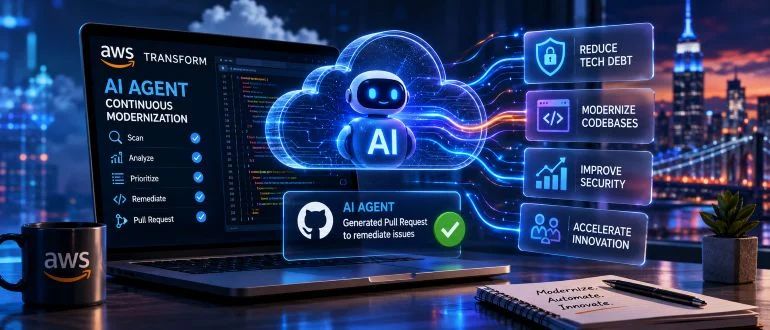

Amazon Web Services (AWS) today made available a preview of an artificial intelligence (AI) agent that has been trained to continuously modernize codebases.
Announced at the AWS New York Summit, the AI agent is being embedded into AWS Transform, the application modernization service AWS launched last year.
Sriram Devanathan, director of AWS Transform, said the autonomous AI agent added to the service will, unlike existing agents, asynchronously execute tasks such as remediating code or analyzing technical debt.
AWS Transform automatically scans your code repositories against configurable baselines and generates findings in hours. Policies for detecting end-of-life dependencies, deprecated frameworks, and other common sources of technical debt are already embedded. If a DevOps team has deprecated an internal library or prefers a particular logging pattern, it can be codified as a policy that runs continuously across code repositories. Once an issue is detected, AI agents will autonomously generate pull requests to remediate any affected repositories automatically.
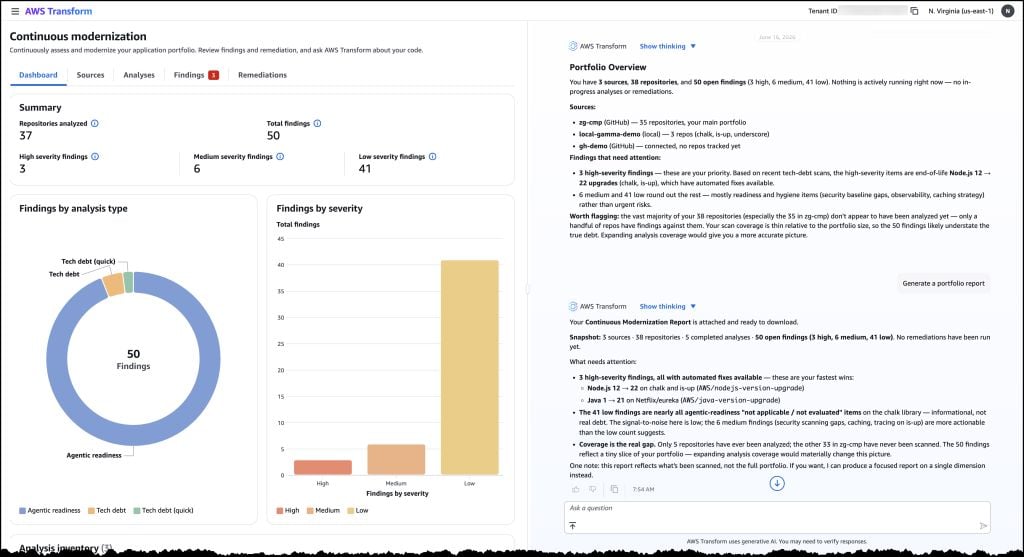
DevSecOps teams can also extend those policies to their own specific remediation patterns, including approved libraries, internal coding standards, or custom technical debt policies they have internally developed. AWS Transform also integrates with the AWS Security Agent to detect and remediate security vulnerabilities at the source-code level, so security findings flow into the same prioritized list and pull-request workflow alongside other analysis of technical debt.
More than 4.5 billion lines of code have already been analyzed and modernized via the AWS Transform service, said Devanathan. In the wake of recent reasoning advances made by frontier models such as Mythos from Anthropic, the level of interest in modernizing codebases to eliminate vulnerabilities has increased sharply in the last few weeks, he added.
Organizations have already been using the AWS Transform service to automate everything from upgrading codebases from one version of Java to another to rewriting legacy code in an entirely different language, noted Devanathan. In the agentic AI era, those efforts will span much more complex initiatives that previously would have required a year or more for a small army of application developers and software engineers to complete.
Mitch Ashley, vice president and practice lead for software lifecycle engineering at the Futurum Group, said the constraint moves from generating fixes to confirming that autonomous pull requests preserve business behavior at scale. The authority granted these agents stays bounded by how well teams can verify that continuous remediation does not quietly change what the application does, he added.
It’s not clear to what degree organizations are modernizing existing applications versus replacing them with software that is becoming simpler to build in the agentic AI era. Regardless of approach, the amount of technical debt that many DevOps teams should address is massive.
Historically, the issue is that every minute spent resolving those issues is one less minute that has been available to develop a new application or add features to an existing one. However, in the agentic AI era, it’s clear the fundamental equations used to determine whether it is cost effective to modernize an application now need to be reevaluated.
from DevOps.com https://ift.tt/n06ORkV
Comments
Post a Comment