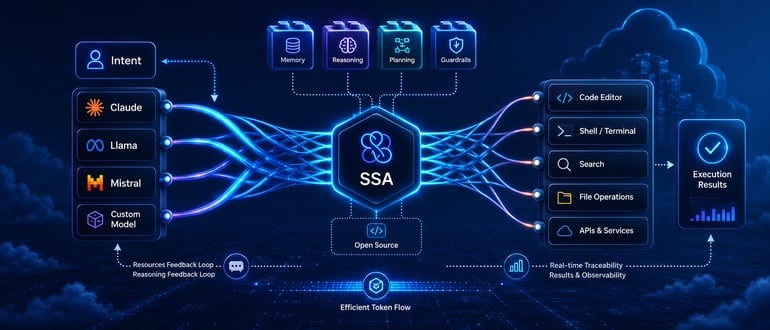

Amazon Web Services (AWS) today previewed a customizable lightweight, open-source harness, dubbed Simple Strands Agent (SSA), that looks to provide a more consistent approach to the interactions that occur between artificial intelligence (AI) coding tools.
Anoop Deoras, director of applied science for agentic AI at AWS, said one of the issues that has arisen in the AI coding era is that the harnesses being used to build applications are too tightly coupled to specific AI models.
The interface used by SSA could make it possible to create a “plug-and-play” architecture that enables AI coding tools to dynamically switch between AI models as needed, said Deoras.
All elements of the SSA harness, including agent logic, tools, prompts, and model configurations, are open-sourced for reproducibility. The overall goal is to minimize an intent-execution gap in a way that can be consistently applied across multiple AI models in a way that serves to both improve accuracy and optimize token consumption, said Deoras.
The research conducted by AWS as it developed SSA confirms AI agent performance is fundamentally a systems problem. A modern agent combines a large language model (LLM) with a harness, software that mediates interaction with tools and manages the cycle of reasoning and feedback. As AI models have improved, a performance bottleneck has emerged from an impedance mismatch in how the harness translates model intent into actions and reflects execution outcomes back to the model.
For example, a model may intend to edit a single instance of a function, while the harness accidentally modifies multiple instances. As a result, AI agents are not using models to their full performance potential because translations of intent are becoming muddled.
In fact, seemingly trivial implementation details lead to nontrivial fluctuations in performance. Factors such as environment interaction timeouts, infrastructure stability, and resource constraints can also materially affect performance. AWS research shows agents with SSA perform better than agents not using SSA when accessing the same model simply because the translation of intent is clearer. Agent design is not entirely model agnostic because different model families exhibit distinct preferences in tool usage, feedback interpretation, and context sensitivity, the AWS research shows.
Mitch Ashley, vice president and practice lead for software lifecycle engineering at the Futurum Group, said competition among providers of AI coding tools now revolves around the harness. However, an open-source, model-agnostic harness will allow DevOps teams to define agent logic, tools, and prompts once and run them on any model, he added.
Decoupling agents from models removes real rework, since teams stop rewriting agent logic every time a better model ships, noted Ashley. The challenge is that even when a harness allows DevOps teams to access multiple models, they can still find themselves locked into a single deployment stack, he noted.
It’s obviously still early days when it comes to agentic AI coding, but it is becoming more apparent that even at this early stage there are decisions being made that could come back to haunt DevOps teams in ways many today don’t quite fully appreciate.
from DevOps.com https://ift.tt/TlmseGM
Comments
Post a Comment