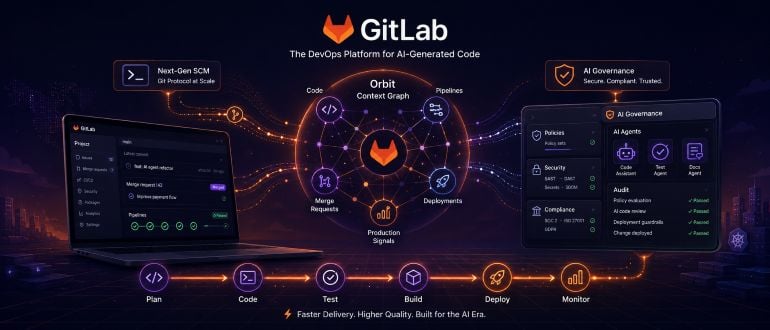

GitLab today, at its Transcend 2026 conference, launched a bevy of updates that collectively optimize its integrated DevOps platform for the volume of code being generated by artificial intelligence (AI) coding tools.
At the core of that effort is a Next Generation Source Code Management, a re-vamped implementation of the Git protocol that is based on a distributed architecture that makes it possible to scale DevOps workflows in a way that enables AI agents to complete tasks 50 times faster
Manav Khurana, chief product and marketing officer for GitLab, said this implementation of the Git protocol takes advantage of distributed processing and storage engines to meet the requirements of DevOps workflows that are increasingly being driven by AI coding tools and associated agents. Additionally, GitLab is also now able to limit server-side queries to only what the actual task requires.
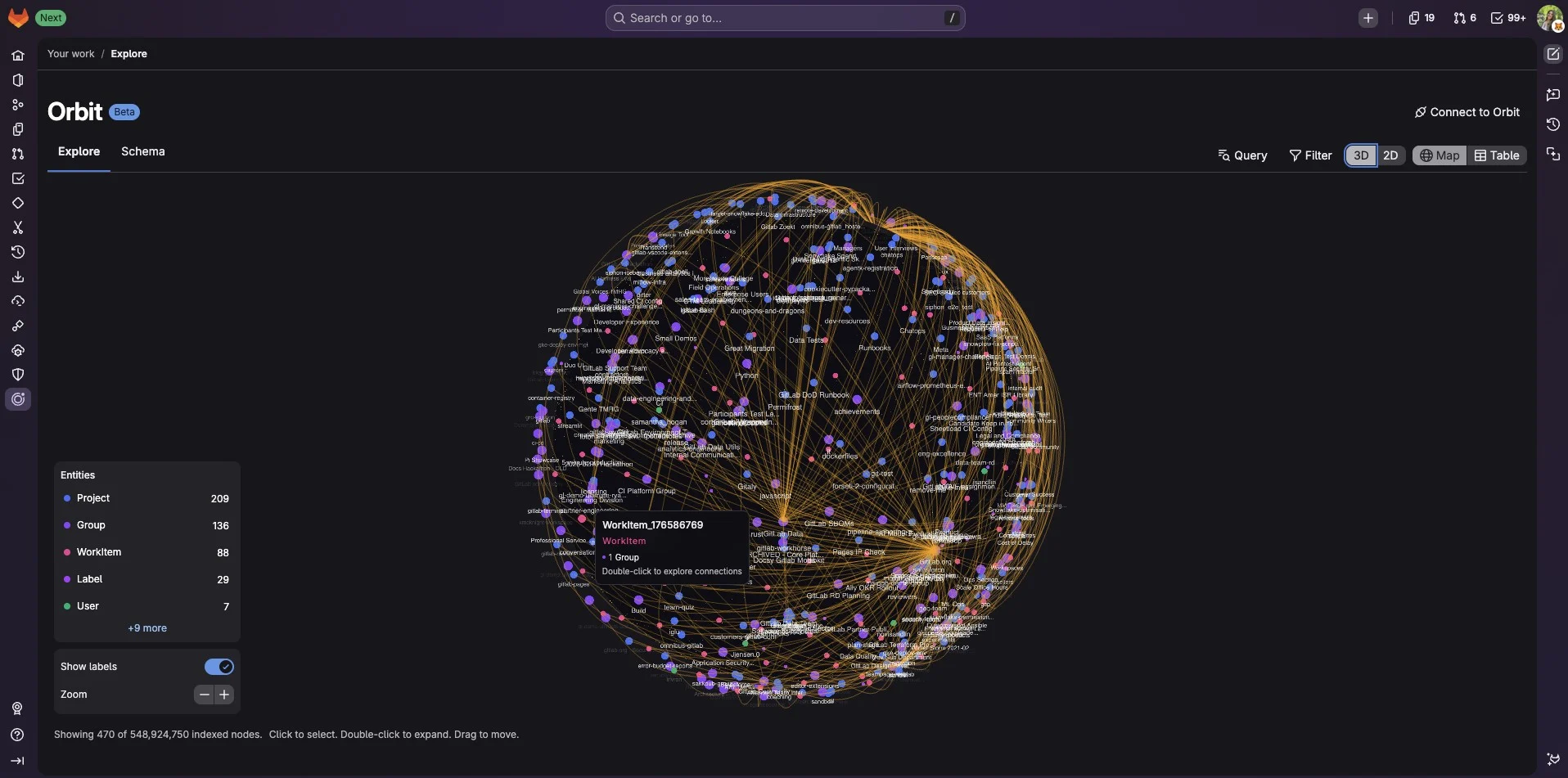
At the same time, GitLab is adding a context graph, dubbed GitLab Orbit, that maps code, work items, pipelines, deployments, and production signals in a way that AI coding tools and agents can query. Available in a public beta, that capability is crucial in the age of AI because it reduces the number of tokens that would otherwise need to be consumed to complete each task, said Khurana. Overall, GitLab Orbit can deliver 11 times faster responses while requiring up to 4.5 times fewer tokens, the company claims.
GitLab is also making available in private beta an AI Governance framework that assigns an identity, a policy path, and an audit record to each and every agent action. DevSecOps teams are now provided with real-time visibility into agent inputs, reasoning, tool calls, and anomalous patterns across the organization. They can also apply policies, such as requiring code scans, across the entire workflow, said Khurana.
Finally, GitLab is rolling out GitLab Flex, a licensing option that combines seats and AI credits in a single annual commitment. DevOps teams can shift spend as needed without having to negotiate contracts between these two as needs change, without the need for contract renegotiation, while finance teams are provided with tools that track consumption against the plan.
These capabilities collectively will enable software engineering teams to benefit from AI coding without the current level of chaos, including cost overruns, security and reliability issues, that many organizations are now experiencing, said Khurana. By providing the tools they need to manage agentic workflows, software engineering teams via a highly integrated GitLab platform remain in control of the DevOps loop, he added.
Mitch Ashley, vice president and practice lead for software lifecycle engineering at The Futurum Group, said the DevOps platform is becoming the control plane for agentic software engineering. GitLab’s Transcend updates attach identity, policy, and an audit record to every agent action, shifting the platform from automating pipelines to governing the agents inside them, he added.
Engineering and DevSecOps teams now evaluate platforms on whether agent actions can be attributed, observed, and governed at the action level, with the autonomy granted being bounded by the visibility their platform provides into agent reasoning and tool calls, said Ashley.
It’s not clear to what degree DevOps teams might be considering new tools and platforms for the age of agentic, but many of the workflows that are relied on today were clearly designed for a previous era that did not see nearly as much code moving through the pipeline. The challenge and the opportunity now is not just simply to generate code faster but, more importantly, to dramatically increase the percentage of that code that ultimately winds up safely running in a production environment.
from DevOps.com https://ift.tt/jvDmLQx
Comments
Post a Comment