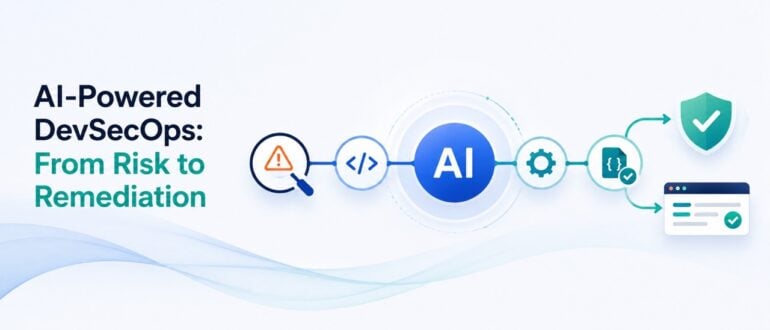
Artificial Intelligence is pushing DevSecOps into a new phase where security is no longer just about detecting vulnerabilities, but increasingly about resolving them automatically within the flow of software delivery. As many organizations are discovering, DevSecOps historically gave teams visibility into risk. AI is now turning that visibility into automated remediation. This evolution has taken place across four phases.
From Discovery to Action
One of the most significant shifts is that security tooling no longer stops at identifying problems. AI systems can detect an issue, recommend a fix, open a ticket, update code, or prepare a pull request for human approval. Traditional DevSecOps created strong visibility into vulnerabilities, but often lacked mechanisms to ensure remediation happened quickly and consistently. AI is helping close that gap between insight and action.
In many environments, when a vulnerable library or dependency is detected, AI systems can automatically test security patch upgrades against established design patterns, validate compatibility with the codebase, and propose or implement the upgrade. This significantly shortens remediation cycles and reduces the burden on development teams.
From Shift-Left to In-Line Guidance
Security traditionally entered the process after code was written and passed through the pipeline for scanning. The shift-left movement pushed security earlier in development, but AI is now embedding security guidance directly into the moment of creation.
Instead of relying only on downstream scanning tools, developers can receive real-time recommendations while writing code. AI-assisted development environments can flag insecure patterns, recommend safer alternatives, and highlight compliance considerations instantly.
The next stage beyond shift-left is effectively in-line security, where guidance appears exactly where developers are making decisions. At Apexon, for example, approaches such as “context governance cards” are designed to embed security as an ambient layer within development workflows so developers remain continuously aware of security implications while building software.
From Manual Review to Policy-Enforced Delivery
Security and compliance verification has historically depended on manual checks to confirm that standards were followed. AI is helping convert many of these requirements into embedded controls within the delivery pipeline.
Agent-based models can distribute responsibilities across specialized roles such as a policy recommender, a policy implementor, and a policy evaluator. This structure reinforces separation of duties while allowing governance to be enforced programmatically.
In this model, security policies gradually move from documentation to execution. Instead of being guidelines teams must remember to follow, they increasingly operate as automated controls that run inside the pipeline.
From Fragmented Tooling to Unified Control Planes
Most enterprises still manage security through a patchwork of disconnected tools across developer environments, CI/CD pipelines, cloud platforms, and enterprise risk systems. AI-enabled platforms are beginning to unify signals across these environments into a more coherent control plane.
This allows organizations to correlate development activity, infrastructure posture, and risk exposure in real time, giving engineering teams greater speed while providing leadership clearer visibility into overall security posture.
At the same time, AI is highlighting new supply-chain risks in software development. When widely used dependencies are compromised, downstream packages can inherit those vulnerabilities at scale. As AI accelerates software development, ensuring the integrity of the software supply chain is becoming one of the defining security challenges organizations must address. Mechanisms such as cryptographically signed package dependencies are likely to become standard practice in modern software delivery environments.
Any DevSecOps model must be driven by continuous insight, traced and generated from prototype-to-production process, covering Agile development practice, security, automation and operational practices.
from DevOps.com https://ift.tt/EhseC0V
Comments
Post a Comment