It wasn’t that long ago that AI assistants just watched from the sidelines. They could answer your questions, explain how things worked, sum up logs, and write deployment scripts. Handy, sure, but the real decisions? Still up to the engineers.
That’s changing now.
AI agents are stepping right into the heartbeat of operations. They can peek into monitoring platforms, tweak cloud settings, kick off deployments, change configs, restart services, you name it. For a lot of teams, giving AI this kind of access feels like the next obvious step in automation. If an AI finds a problem, why not let it fix it? If it can see a deployment fail, why not just roll things back automatically? If it spots resources running low, let it bump them up. On paper, it makes perfect sense.
But here’s the catch. Production environments never really stick to the script.
As AI agents start mixing directly with ops, DevOps folks find themselves in a new era. The hard part isn’t just what these agents can do. It’s what happens when they make the wrong call.
A Shift from Assistants to Operators
Traditional automation is pretty straightforward. Think playbooks and pipelines, a set of steps, clear triggers, and rules. The system just follows instructions.
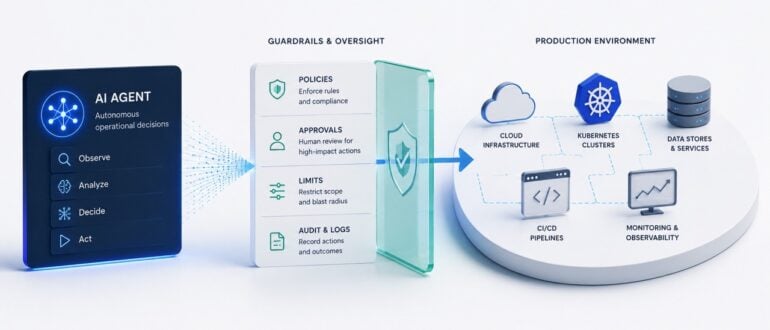
AI agents don’t work like that. Instead of sticking to a script, they look at what’s happening, figure out the context, and decide what to do next. They can pull in info from all over, combine data, weigh options, and act, often on their own.
That’s a big shift. Now automation isn’t just about running instructions. It’s about making decisions.
And in complex systems, decisions aren’t always clear cut. Stuff breaks in ways nobody expects.
Why Teams Want This
It’s not hard to see the upside.
Ops teams deal with endless repetitive tasks, digging through alerts, hunting for clues in logs, running rollbacks, rebooting services, updating configs, fixing issues that always seem to pop up at the worst times.
AI agents promise to shoulder some of this load. Instead of ripping someone out of bed for every alert, an agent can investigate first. Rather than sifting through thousands of log entries, the AI can pinpoint the real cause almost instantly. It can even jump in to start fixes before humans have time to gather.
At scale, these superpowers are tempting. Faster response means better uptime. Faster recovery means smaller outages. Less grunt work means happier, less burned out teams.
But these same abilities come with their own risks.
Where AI Falls Short
AI agents are powerful because they process huge amounts of data. But production environments need more than that. They need real understanding.
Let’s say an AI figures out that response times got worse after a deployment. Roll back the deployment, right? Usually, yes. But sometimes, the deployment wasn’t the problem. Maybe the real issue was a flaky external service. Or maybe rolling back would reopen a security hole that was just closed. Sometimes the deployment contains a must have compliance patch.
Human engineers weigh these factors. They know the context, the history, the business priorities. AI agents? They stick to what they can see in the data.
And plenty of important things just aren’t in the data.
Small Mistakes Big Problems
The most dangerous failures rarely start with drama. They start small, a config tweak, a tiny permission change, a reroute, a single deployment action. Each one seems harmless, but at scale, mistakes snowball fast.
Imagine an AI agent tries to fix lag by rerouting traffic. At first, it works. Problem solved. But hours later, engineers realize the traffic has been sent to less reliable systems. Now costs are up, and new outages crop up elsewhere. The original problem vanishes, but another one takes its place. The AI did what it was supposed to do, but missed the bigger picture.
Automation repeats mistakes much faster than humans ever could.
Security Gets Trickier
Once an AI agent holds the keys to production, security suddenly moves to the top of the list. To do its job, the agent needs access, cloud resources, deployment tools, monitoring data. Each new permission is both a power and a risk.
A human account getting hacked is already bad news. An unsupervised AI system with production access? That’s an even bigger headache. Teams have to figure out what’s safe for the agent to do, what actions need a human sign off, how to keep permissions tight enough, and how to monitor and audit what the AI is doing.
Without real guardrails, AI agents become powerful actors with little oversight. That’s not just a tech problem. It’s a security problem.
Watching AI Agents Not Just Systems
Traditionally, observability was about keeping an eye on your infrastructure, servers, networks, applications. Now, teams have to watch what AI agents are up to as well.
Why did the agent restart something? Why did it change that configuration? Why did it trigger a rollback now? Why’d it ignore some signals but act on others?
If engineers can’t see the logic behind these moves, it’s tough to trust the system. Transparency matters more than ever. Teams need to know what happened, but more importantly, why.
People Still Matter
There’s a lot of buzz about autonomous operations. Some folks say AI agents will end up managing whole production environments solo. In reality, the smartest approach balances speed and context.
AI agents are great at crunching data, finding patterns, connecting dots across systems. Human engineers bring context, understanding what really matters, managing tradeoffs when objectives clash, handling risk.
You don’t need the AI to replace people. You need it to boost what people do best. That’s where AI shines, amplifying human expertise.
What’s Next
Giving AI access to production is a big milestone. The industry is clearly shifting from simple helpers to operational agents. That opens up new possibilities, but also means more responsibility.
If you roll out AI without thinking through safeguards, you might walk right into trouble. But if you combine smart automation with good controls, strong oversight, and solid observability, you’re setting yourself up to move faster with confidence.
The tech will keep evolving, and operational discipline has to keep pace.
Final Thoughts
AI agents are rapidly getting smarter. They can analyze incidents, investigate breakdowns, and tackle operational tasks at impressive speed. For DevOps teams, that means a new wave of automation is on the rise.
But speed isn’t enough on its own. Production needs judgment, accountability, security, and trust. Giving AI more power could unlock massive value, or open new risk.
The future won’t be about just what AI can do. It’ll be about how well we control what it’s allowed to do, and that will make all the difference.
from DevOps.com https://ift.tt/hmTVqpN
Comments
Post a Comment